



 Chat with AI
Exam 13: Capital, Interest, and Corporate Finance

Exam 1: The Art and Science of Economic Analysis162 Questions
Exam 1: Appendix--Understanding Graphs71 Questions
Exam 2: Economic Tools and Economics Systems211 Questions
Exam 3: Economic Decision Makers207 Questions
Exam 4: Demand, Supply, and Markets245 Questions
Exam 5: Elasticity of Demand and Supply244 Questions
Exam 5: Appendix--Price Elasticity and Tax Incidence32 Questions
Exam 6: Consumer Choice and Demand171 Questions
Exam 6: Appendix--Indifference Curves and Utility Maximization107 Questions
Exam 7: Production and Cost in the Firm218 Questions
Exam 8: A--Perfect Competition250 Questions
Exam 8: B--Perfect Competition25 Questions
Exam 9: A--Monopoly249 Questions
Exam 9: B--Monopoly18 Questions
Exam 10: Monopolistic Competition and Oligopoly233 Questions
Exam 11: Resource Markets219 Questions
Exam 12: Labor Markets and Labor Unions218 Questions
Exam 13: Capital, Interest, and Corporate Finance190 Questions
Exam 14: Transaction Costs, Imperfect Information, and Behavioral Economics187 Questions
Exam 15: Economic Regulation and Antitrust Policy179 Questions
Exam 16: Public Goods and Public Choice143 Questions
Exam 17: Externalities and the Environment203 Questions
Exam 18: Income Distribution and Poverty130 Questions
Exam 19: International Trade172 Questions
Exam 20: International Finance226 Questions
Exam 21: Economic Development97 Questions
Select questions type


If we assume that a unit of capital will last indefinitely, the marginal rate of return on investment equals the marginal revenue product of capital divided by its marginal resource cost.
(True/False)
4.9/5  (96)
(96) If the interest rate increases from 6 percent to 10 percent per year, each $100 saved will earn
(Multiple Choice)
4.9/5 (77)
(77) If the discount rate is 5 percent, the present value of annual $100, 000 payments in perpetuity (i.e., continued indefinitely into the future)is
(Multiple Choice)
4.8/5 (69)
(69) Exhibit 13-9 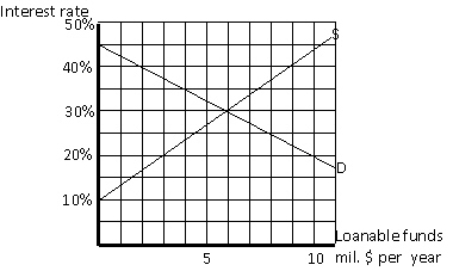 In the market for loanable funds depicted in Exhibit 13-9, what is the equilibrium amount of loanable funds exchanged?
 (Multiple Choice)
4.8/5 (85)
(85) If you will receive $3, 000 three years from today and the discount rate is 7 percent, the present value of the $3, 000 is
(Multiple Choice)
4.8/5 (81)
(81) If you hold a bond at a time when market interest rates are increasing, you will find that the bond's value has
(Multiple Choice)
4.9/5 (74)
(74) The present value of receiving M dollars in year t when the prevailing interest rate is i is equal to
(Multiple Choice)
4.9/5 (89)
(89) A payment of $105 next year can be more valuable than a payment of $100 now.
(True/False)
4.7/5 (84)
(84) If a firm can borrow or lend at a 10 percent annual interest rate, it will
(Multiple Choice)
5.0/5 (80)
(80) Goods and activities typically are more highly valued the sooner they can be enjoyed, other things constant,
(Multiple Choice)
4.9/5 (81)
(81) Which of the following does not reflect a positive rate of time preference?
(Multiple Choice)
4.9/5 (81)
(81) If financial intermediaries charge a higher rate of interest to lenders than they pay to borrowers, then
(Multiple Choice)
4.8/5 (71)
(71) Administrative costs make small loans less profitable than large ones, other things equal.
(True/False)
4.7/5 (70)
(70) If the market interest rate is 5 percent, the opportunity cost of $100 worth of present consumption
(Multiple Choice)
4.9/5 (77)
(77) Exhibit 13-7  In Exhibit 13-7, if the interest rate is 8 percent, investment will equal approximately
 (Multiple Choice)
4.9/5 (86)
(86) There is an inverse relationship between the present value of a future amount and the interest rate used for discounting.
(True/False)
4.8/5 (85)
(85) Suppose an investment will yield $1, 000 after one year and $2, 000 after two years.What is the present value of this investment if the discount rate is 8 percent?
(Multiple Choice)
4.7/5 (86)
(86) 
Filters
- Essay(0)
- Multiple Choice(0)
- Short Answer(0)
- True False(0)
- Matching(0)