



 Chat with AI
Exam 15: Economic Regulation and Antitrust Policy

Exam 1: The Art and Science of Economic Analysis162 Questions
Exam 1: Appendix--Understanding Graphs71 Questions
Exam 2: Economic Tools and Economics Systems211 Questions
Exam 3: Economic Decision Makers207 Questions
Exam 4: Demand, Supply, and Markets245 Questions
Exam 5: Elasticity of Demand and Supply244 Questions
Exam 5: Appendix--Price Elasticity and Tax Incidence32 Questions
Exam 6: Consumer Choice and Demand171 Questions
Exam 6: Appendix--Indifference Curves and Utility Maximization107 Questions
Exam 7: Production and Cost in the Firm218 Questions
Exam 8: A--Perfect Competition250 Questions
Exam 8: B--Perfect Competition25 Questions
Exam 9: A--Monopoly249 Questions
Exam 9: B--Monopoly18 Questions
Exam 10: Monopolistic Competition and Oligopoly233 Questions
Exam 11: Resource Markets219 Questions
Exam 12: Labor Markets and Labor Unions218 Questions
Exam 13: Capital, Interest, and Corporate Finance190 Questions
Exam 14: Transaction Costs, Imperfect Information, and Behavioral Economics187 Questions
Exam 15: Economic Regulation and Antitrust Policy179 Questions
Exam 16: Public Goods and Public Choice143 Questions
Exam 17: Externalities and the Environment203 Questions
Exam 18: Income Distribution and Poverty130 Questions
Exam 19: International Trade172 Questions
Exam 20: International Finance226 Questions
Exam 21: Economic Development97 Questions
Select questions type


A regulated natural monopoly that must set price equal to average cost will
(Multiple Choice)
4.9/5  (80)
(80) Exhibit 15-2  The welfare loss associated with the unregulated natural monopoly in Exhibit 15-2 is shown by the area
 (Multiple Choice)
4.9/5 (93)
(93) As concentration in an industry increases, the Herfindahl index falls.
(True/False)
4.7/5 (76)
(76) Price discrimination that substantially lessens competition is prohibited by the Clayton Act.
(True/False)
4.8/5 (72)
(72) Ersatz Kreme will sell its filling to Hunky Donuts only if Hunky Donuts agrees not to buy filling from other suppliers.This is an example of
(Multiple Choice)
4.9/5 (83)
(83) Which of the following U.S.antitrust laws prohibits mergers through the acquisition of a firm's assets if the merger would lessen competition?
(Multiple Choice)
4.9/5 (79)
(79) The government often enacts regulation that benefits producers because
(Multiple Choice)
4.9/5 (77)
(77) The ability of a firm to raise the price without losing all its sales to rivals is called
(Multiple Choice)
4.8/5 (78)
(78) Exhibit 15-5 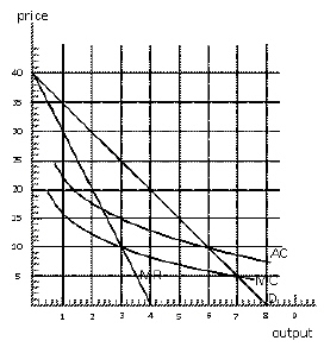 The natural monopoly depicted in exhibit 15-5, if unregulated would earn how much profit?
 (Multiple Choice)
4.8/5 (78)
(78) If the government wishes to provide a natural monopolist with a "fair" rate of return, it will force the firm to set
(Multiple Choice)
4.9/5 (70)
(70) Exhibit 15-2  In Exhibit 15-2, the increase in consumer surplus that occurs when price is set equal to marginal cost rather than at the profit-maximizing level, as it would be in an unregulated monopoly, is shown by area
 (Multiple Choice)
4.9/5 (72)
(72) Exhibit 15-4  If regulators allow the natural monopolist in Exhibit 15-4 to earn only a normal profit, it will result in an increase in consumer surplus compared to the profit maximizing result.
 (True/False)
4.7/5 (92)
(92) The average cost curve for a natural monopoly is downward sloping where it intersects the market demand curve.
(True/False)
4.7/5 (86)
(86) There are five firms in the cresset industry.The market shares of the five firms are 60 percent, 15 percent, 15 percent, 6 percent, and 4 percent.The Herfindahl index is
(Multiple Choice)
4.9/5 (75)
(75) If a firm with a 20 percent market share merges with a firm with 5 percent of the market, by how much will the Herfindahl index change? The other firms have 40 percent, 15 percent, 10 percent, and 10 percent shares.
(Multiple Choice)
4.8/5 (87)
(87) 
Filters
- Essay(0)
- Multiple Choice(0)
- Short Answer(0)
- True False(0)
- Matching(0)