Multiple Choice
Table 7.6
Burdell Industries makes four different models of computer printers: the E-1000,the S-2000,the P-2000 and the N-1000.The E-1000 sells for $200 and has $40 in parts and $40 in labor;the S-2000 sells for $150 and requires $30 in parts and $30 in labor;the P-2000 sells for $100 and has $20 in parts and $20 in labor;and the N-1000 sells for $75 but requires only $10 of parts and $10 of labor.Fixed overhead is estimated at $5,000 per week.The manufacture of each printer requires four machines,Machines #1,2,3 and 4.Each of the machines is available for 40 hours a week and there is no setup time required when shifting from the production of one product to any other.The processing requirements to make one unit of each product are shown in the table.Weekly product demand for the next planning period has been forecasted as follows: 80 E-1000s;65 S-2000s;35 P-2000s;and 20 N-1000s. 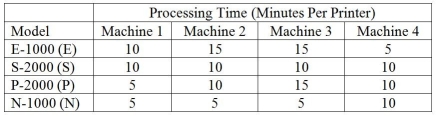 In the questions that follow,the traditional method refers to maximizing the contribution margin per unit for each product,and the bottleneck method refers to maximizing the contribution margin per minute at the bottleneck for each product.
-Use the information in Table 7.6.Using the traditional method,which product should be scheduled first?
A) Product E
B) Product S
C) Product P
D) Product N
Correct Answer:

Verified
Correct Answer:
Verified
Q46: What is contribution margin for a product?
Q50: _ is the maximum time allowed for
Q70: The most controversial aspect of line-flow layout
Q85: A(n) _ is an operation that has
Q99: According to the Theory of Constraints,brand new
Q100: Table 7.11<br>The Pennsylvania Appliance Company is installing
Q101: Figure 7.1 <img src="https://d2lvgg3v3hfg70.cloudfront.net/TB2904/.jpg" alt="Figure 7.1
Q103: Practical application of the Theory of Constraints
Q107: Balance the assembly line using the following
Q109: Schmidt Industries makes four different snake traps;the