Multiple Choice
For the simplified representation of an enzyme-catalyzed reaction shown below, the statement "ES is in steady-state" means that: 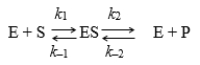
A) k2 is very slow.
B) k1 = k2.
C) k1 = k-1.
D) k1[E][S] = k-1[ES] + k2[ES].
E) k1[E][S] = k-1[ES].
Correct Answer:

Verified
Correct Answer:
Verified
Related Questions
Q86: The enzyme pepsin is produced in the
Q87: Why is the Lineweaver-Burk (double reciprocal) plot
Q88: The allosteric enzyme ATCase is regulated by
Q89: A small molecule that DECREASES the activity
Q90: The role of the metal ion (Mg<sup>2+</sup>)
Q92: Why does pH affect the activity of
Q93: The role of an enzyme in an
Q94: Which molecule would NOT be effective to
Q95: Which enzymes are NOT among the six
Q96: Describe why the Michaelis constant (K<sub>m</sub>) and