Multiple Choice
Table 17-23
Two bottled beverage manufacturers (Firm A and Firm B) determine that they could lower their costs, and thus increase their profits, if they reduced their advertising budgets. But for the plan to work, each firm must agree to refrain from advertising. Each firm believes that advertising works by increasing the demand for the firm's product, but each firm also believes that if neither firm advertises, the costs savings will outweigh the lost sales. Listed in the table below are the individual profits for each firm. 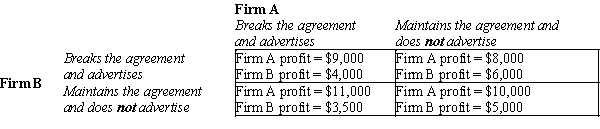
-Refer to Table 17-23. Suppose that the two firms, A and B, make an agreement to withhold any advertising for one month to lower each firm's costs and raise each firm's profits. If the firms reach the Nash equilibrium,
A) both firms will choose not to advertise.
B) firm A will choose not to advertise, but firm B will break the agreement and choose to advertise.
C) firm B will choose not to advertise, but firm A will break the agreement and choose to advertise.
D) both firms will break the agreement and choose to advertise.
Correct Answer:

Verified
Correct Answer:
Verified
Q33: If all of the firms in an
Q50: In markets characterized by oligopoly,<br>A) the oligopolists
Q62: Briefly describe the business practice of tying.
Q194: Tying can be thought of as a
Q265: Table 17-19<br>Consider a small town that has
Q266: Figure 17-2. Two companies, Acme and Pinnacle,
Q268: Figure 17-1 <img src="https://d2lvgg3v3hfg70.cloudfront.net/TB1273/.jpg" alt="Figure 17-1
Q269: Table 17-2<br>Imagine a small town in which
Q271: Figure 17-5. Two companies, ABC and QRS,
Q275: Table 17-1<br>Imagine a small town in which