Multiple Choice
The figure shows the phylogeny of snakes, Gila monsters, and their relatives. If venom production in snakes and Gila monsters is a homologous trait, would you expect to find venom production in other lizards and iguanas? 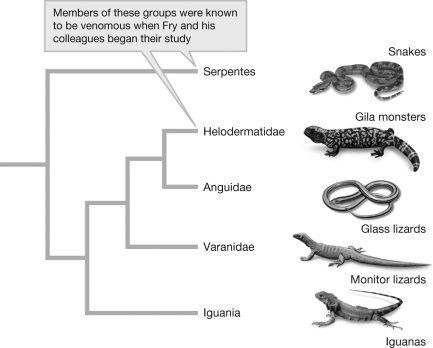
A) No. Gila monsters share a common ancestor with other lizards and iguanas, but not with snakes; therefore, the presence of venom production in snakes and Gila monsters does not allow us to hypothesize about venom production in other species.
B) No. Homologous traits do not evolve easily; therefore, we would not expect other species to have evolved venom production.
C) Yes. If venom is homologous, then the common ancestor of snakes and Gila monsters would have produced venom and it is likely that the other descents of that ancestor would also produce venom.
D) Yes. Because snakes and Gila monsters independently evolved venom production, it seems likely that other lizards and iguanas would also be able to evolve venom production.
Correct Answer:

Verified
Correct Answer:
Verified
Q15: If the tree shown in the figure
Q16: On a phylogram, what do branch lengths
Q17: Although they serve no known current functions,
Q18: Assume you are an evolutionary biologist who
Q19: Aposematic, or warning, coloration in poison frogs
Q21: A trait that is similar in one
Q22: The study of phylogeny rests on our
Q23: What does the study of phylogeny allow
Q24: Based on the phylogenetic tree, which of
Q25: The figure shows where tetrapod limbs evolved