Solved

Which of the Following Was Not a Good Predictor of Physical

Question 5

Multiple Choice

Which of the following was not a good predictor of physical health in this example? In their study of 'Using individual growth model to analyse the change in quality of life from adolescence to adulthood' (2006) , Chen and Cohen conducted interviews on 3 different occasions over a period of time and the following graph demonstrates the physical health changes noted over these 3 periods in 20 of their sample.
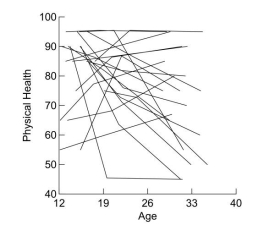
Which of the following was not a good predictor of physical health in this example? In their study of 'Using individual growth model to analyse the change in quality of life from adolescence to adulthood' (2006) , Chen and Cohen conducted interviews on 3 different occasions over a period of time and the following graph demonstrates the physical health changes noted over these 3 periods in 20 of their sample.   Individual Physical Health Change (raw data, n = 20)  Chen and Cohen Health and Quality of Life Outcomes 2006 4:10 doi:10.1186/1477-7525-4-10 The following results are obtained from fitting the unconditional linear growth model. Table 1   A)  Age B)  Gender C)  Psychiatric disorder D)  None of the above Individual Physical Health Change (raw data, n = 20)
Chen and Cohen Health and Quality of Life Outcomes 2006 4:10 doi:10.1186/1477-7525-4-10
The following results are obtained from fitting the unconditional linear growth model.
Table 1
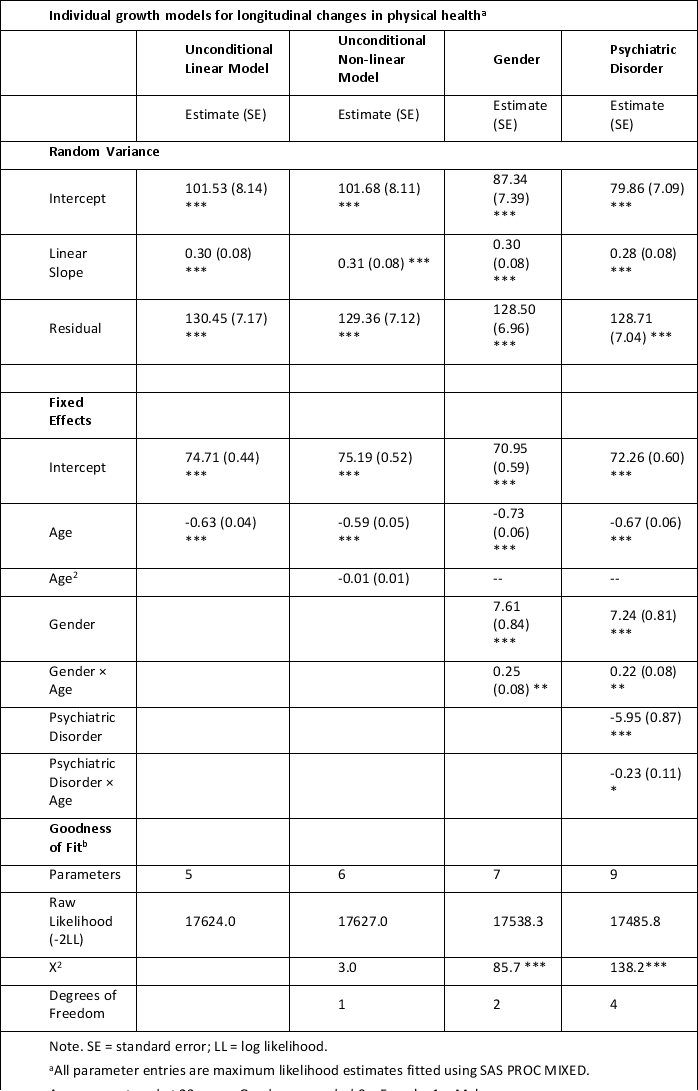
Which of the following was not a good predictor of physical health in this example? In their study of 'Using individual growth model to analyse the change in quality of life from adolescence to adulthood' (2006) , Chen and Cohen conducted interviews on 3 different occasions over a period of time and the following graph demonstrates the physical health changes noted over these 3 periods in 20 of their sample.   Individual Physical Health Change (raw data, n = 20)  Chen and Cohen Health and Quality of Life Outcomes 2006 4:10 doi:10.1186/1477-7525-4-10 The following results are obtained from fitting the unconditional linear growth model. Table 1   A)  Age B)  Gender C)  Psychiatric disorder D)  None of the above


A) Age
B) Gender
C) Psychiatric disorder
D) None of the above

Correct Answer:

verifed

Verified

Unlock this answer now
Get Access to more Verified Answers free of charge

Related Questions