Multiple Choice
Giardia intestinalis can cause disease in several different mammalian species, including humans. Giardia organisms (G. intestinalis) that infect humans are similar morphologically to those that infect other mammals, thus they have been considered a single species. However, G. intestinalis has been divided into different subgroups based on their host and a few other characteristics.
In 1999, a DNA sequence comparison study tested the hypothesis that these subgroups actually constitute different species. The following phylogenetic tree was constructed from the sequence comparison of rRNA from several subgroups of G. intestinalis and a few other morphologically distinct species of Giardia. The researchers concluded that the subgroups of Giardia are sufficiently different from one another genetically that they could be considered different species. (T. Monis, et al. 1999. Molecular systematics of the parasitic protozoan Giardia intestinalis. Mol. Biol. Evol. 16[9]:1135-44.) 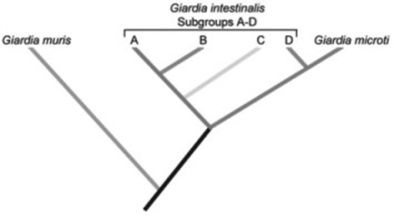
-
Which of the following changes would a modern systematist be most likely to make after learning of the results of the rRNA analyses?
A) continue to keep subgroups A-D as members of the species G. intestinalis
B) break the species G. intestinalis into four separate species, A, B, C, and D
C) combine subgroup D and G. microti into one species
D) combine all the subgroups of G. intestinalis (A-D) and G. microti to make one species
Correct Answer:

Verified
Correct Answer:
Verified
Q9: Use the following information to answer the
Q44: Phylogenetic trees constructed from evidence from molecular
Q49: Which of the following statements best describes
Q58: The legless condition that is observed in
Q65: <img src="https://d2lvgg3v3hfg70.cloudfront.net/TB6149/.jpg" alt=" Which of the
Q67: The lakes of northern Minnesota are home
Q69: <img src="https://d2lvgg3v3hfg70.cloudfront.net/TB6149/.jpg" alt=" A phylogenetic tree
Q73: The term convergent evolution is most applicable
Q74: The following question refers to this phylogenetic
Q75: Given that phylogenies are based on