Multiple Choice
The mechanism of cell crawling in protist species is not well defined. Pseudopodia extension involves interactions between actin and myosin (the same molecules that are involved in vertebrate muscle contraction) . However, prior to the study described below, no-one had provided convincing data that actin and myosin were actually involved in cell crawling in protists. Anatomical studies had identified the cytoskeletal protein actin just below the surface of the cell membrane in several species of protist, but physiological studies had failed to show a functional link between actin, myosin, and cell crawling.
In a study by N. Poulsen et al. (Diatom gliding is the result of an actin-myosin motility system, Cell Motility and the Cytoskeleton 44 (1999) :23-22) , researchers tested whether motility in a particular species of diatom involves interactions between actin and myosin. 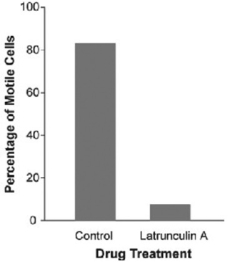
-Refer to the study by Poulsen et al. and the figure above. Cultures of a species of diatom were treated with BDM, a reversible inhibitor of myosin function. Which of the following predictions is consistent with the hypothesis that an actin-myosin interaction is necessary for motility?
A) BDM will significantly decrease motility of the cells in culture.
B) BDM will not significantly alter motility of the cells in culture.
C) BDM will significantly increase motility of the cells in culture.
D) BDM will significantly increase motility of the cells in their natural habitats.
Correct Answer:

Verified
Correct Answer:
Verified
Q6: The genome of modern chloroplasts is roughly
Q12: Diatoms are mostly asexual members of the
Q16: A large seaweed that floats freely on
Q26: In order to determine the "root" of
Q33: Consider the following data:<br>(a) Most ancient eukaryotes
Q33: Giardia intestinalis is an intestinal parasite of
Q37: Which group is incorrectly paired with its
Q45: Living diatoms contain brownish plastids. If global
Q51: In a life cycle with alternation of
Q58: An individual mixotroph loses its plastids, yet