Multiple Choice
In order to test how sea urchin sperm bind to eggs, scientists isolated the egg receptor protein that binds to the sperm acrosomal protein called bindin. Plastic beads were coated with egg receptor for bindin (ERB1) from eggs of the sea urchin Strongylocentrotus purpuratus, and then the beads mixed with sperm from S. purpuratus or from the related species, S. franciscanus. The researchers counted how many sperm were bound to each bead. The results are shown in the graph below. (Adapted from Kamei and Glabe 2003)
Treatments:
A: S. purpuratus sperm mixed with S. purpuratus ERB1 beads
B: S. purpuratus sperm mixed with beads containing no ERB1 protein
C: S. franciscanus sperm mixed with S. purpuratus ERB1 beads
D: S. franciscanus sperm mixed with beads containing no ERB1 protein 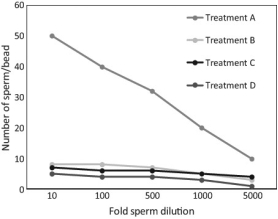
-What is a broader implication from the observations of the experiment?
A) In sea urchins, fertilisation of eggs by sperm is dependent upon species-specific protein interactions.
B) Only some species of sea urchins use receptor proteins on their eggs to bind sperm.
C) Protein-coated plastic beads should not be used to test sperm binding to eggs.
D) S. franciscanus is probably not a sea urchin, but must be some other type of organism.
Correct Answer:

Verified
Correct Answer:
Verified
Q8: Thalidomide, now banned for use as a
Q9: A human blastomere is _.<br>A) an embryonic
Q12: The pattern of embryonic development in which
Q35: The embryonic precursor to the human spinal
Q42: In humans, identical twins are possible because
Q47: The migratory neural crest cells _.<br>A) form
Q47: A reproductive difference between sea urchins and
Q48: Cells move to new positions as an
Q50: At the time of implantation, the human
Q52: What structural adaptation in chickens allows them