Multiple Choice
In order to test how sea urchin sperm bind to eggs, scientists isolated the egg receptor protein that binds to the sperm acrosomal protein called bindin. Plastic beads were coated with egg receptor for bindin (ERB1) from eggs of the sea urchin Strongylocentrotus purpuratus, and then the beads mixed with sperm from S. purpuratus or from the related species, S. franciscanus. The researchers counted how many sperm were bound to each bead. The results are shown in the graph below. (Adapted from Kamei and Glabe 2003)
Treatments:
A: S. purpuratus sperm mixed with S. purpuratus ERB1 beads
B: S. purpuratus sperm mixed with beads containing no ERB1 protein
C: S. franciscanus sperm mixed with S. purpuratus ERB1 beads
D: S. franciscanus sperm mixed with beads containing no ERB1 protein 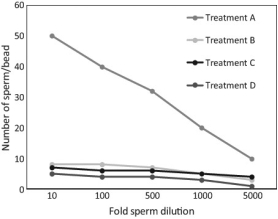
-Based on the data in the graph, which of the following conclusions is supported?
A) Plastic beads will bind to sperm from both species of sea urchin.
B) ERB1 prevents S. franciscanus sperm from binding the beads.
C) Sperm from S. purpuratus bind to beads only if ERB1 is present.
D) S. franciscanus and S. purpuratus are actually the same species.
Correct Answer:

Verified
Correct Answer:
Verified
Q1: Cell migration occurs extensively during _.<br>A) organogenesis,
Q2: The outer-to-inner sequence of tissue layers in
Q24: Changes in the shape of a cell
Q26: Which of the following is an adult
Q27: If an egg cell were treated with
Q28: Which of the following is common to
Q31: The cortical reaction of sea urchin eggs
Q34: Which of the following is a correct
Q36: One primary factor in shaping the polarity
Q37: In some rare salamander species, all individuals