Multiple Choice
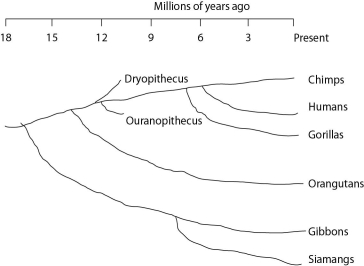 Figure 20.4 Humans, chimpanzees, gorillas, and orangutans are members of a clade called the great apes, which shared a common ancestor about 18 million years ago. Gibbons and siamangs comprise a clade called the lesser apes. Tree-branch lengths indicate elapsed time.
-The great apes comprise the family Hominidae, whereas the lesser apes comprise the family Hylobatidae. If the extant organisms on the far right side of Figure 20.4 comprise the next-most exclusive (i.e., specific) taxon, then they comprise different
A) subspecies.
B) species.
C) genuses.
D) genera.
E) orders.
Correct Answer:

Verified
Correct Answer:
Verified
Q8: <img src="https://d2lvgg3v3hfg70.cloudfront.net/TB6148/.jpg" alt=" Figure 20.1 -Which
Q18: Neutral theory proposes that<br>A) molecular clocks are
Q19: The next questions refer to the following
Q25: Traditionally, whales and hippopotamuses have been classified
Q25: The importance of computers and of computer
Q29: The following questions refer to the phylogenetic
Q29: If it turns out that the whale
Q43: Which of the following are the best
Q62: If organisms A, B, and C belong
Q73: Together, the lesser apes and great apes