Multiple Choice
The family Felidae (cats) is distributed across Africa, Eurasia, North America, and South America and is hypothesized to have eight major lineages (Panthera, bay cat, caracal, ocelot, lynx, puma, leopard, and domestic cat groups) as shown in this phylogenetic tree, constructed from DNA sequences. Scientists used a molecular clock and fossil evidence to date the divergence of each group. The dates of divergence are provided in the accompanying figure.
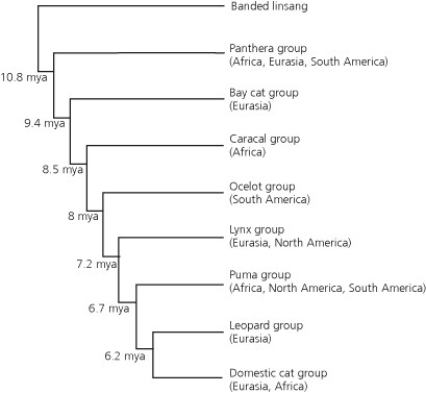
-The Manx cat is in the domestic cat group, and the bobcat is in the lynx group. Both have a trait in common: short, stubby tails. According to the phylogeny, which is the most parsimonious explanation for this common trait in these two species of cat?
A) The common ancestor of the Manx cat and bobcat had a short, stubby tail.
B) Horizontal gene transfer between the Manx cat and bobcat occurred.
C) The short, stubby tail evolved independently in these two species.
D) Short, stubby tails were advantageous about 9 million years ago.
Correct Answer:

Verified
Correct Answer:
Verified
Q38: _ makes it possible to trace phylogenies
Q39: The family Felidae (cats) is distributed across
Q40: The model of species selection is analogous
Q41: Cave-dwelling catfish and cave-dwelling salamanders share striking
Q42: Which of the following environments is thought
Q44: According to the accompanying figure, if a
Q45: In accordance with the principle of parsimony,
Q46: If an isotope has a half-life of
Q47: Miller was the first to show that<br>A)
Q48: Scientists hypothesize that a major factor promoting