Multiple Choice
In southern Africa, jackals are major predators of livestock on farms. As a control measure, farmers often kill jackals they find on their farms. Scientists Liaan Minnie and colleagues predicted that increased mortality of jackals would result in altered life history traits of this carnivore species. To test their predictions, they compared the number of pregnant female jackals in different age classes in populations that were hunted (on farms) to those that were not hunted (in conservation reserves) . The resulting pattern shown in the first graph is the proportion of females that are pregnant in each age class. The scientists also collected demographic data to construct age structure diagrams (second graph) of jackals in (a) hunted populations (farms) and (b) populations that were not hunted (reserves) . In the age structure diagram, males are plotted on the left, females are plotted on the right, and the median age class is denoted with hatched bars.
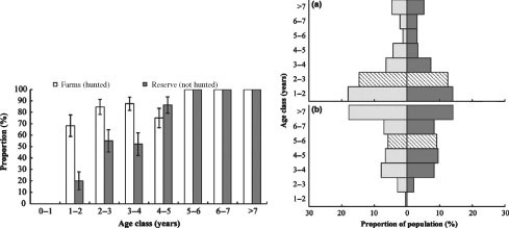 Source: Minnie, L., Gaylard, A., & Kerley, G. I. (2016) . Compensatory life‐history responses of a mesopredator may undermine carnivore management efforts. Journal of Applied Ecology, 53(2) , 379-387.
-Jackals live in socially organized groups, with dominant females suppressing reproduction in nondominant (submissive) individuals. Examine the first graph, and select the explanation that best predicts the effect of dominance hierarchies on population growth in jackals.
A) On farms, older individuals suppress younger individuals from reproducing. A smaller proportion of pregnant females would make farm populations grow more slowly than reserve populations.
B) On farms, younger individuals suppress older individuals from reproducing. A smaller proportion of pregnant females would make farm populations grow more slowly than reserve populations.
C) On reserves, older individuals suppress younger individuals from reproducing. A smaller proportion of pregnant females would make reserve populations grow more slowly than farm populations.
D) On reserves, younger individuals suppress older individuals from reproducing. A smaller proportion of pregnant females would make reserve populations grow more slowly than farm populations.
Correct Answer:

Verified
Correct Answer:
Verified
Q18: An ecological footprint<br>A) is a means of
Q19: An African family that has been displaced
Q20: A survivorship curve that shows a population
Q21: Which is a practical application of population
Q22: In southern Africa, jackals are major predators
Q24: You drive through Iowa in the spring
Q25: As a growing population nears its carrying
Q26: A population of fungi in a yard
Q27: The death by bubonic plague of about
Q28: A population of deer has a per