Multiple Choice
Japanese stiltgrass is an invasive plant that was accidentally introduced to the United States in the early 1900s. It can be found on roadsides and in forests, and it has many impacts on native plants and animals. Biologists Jayna DeVore and John Maerz studied the effect of Japanese stiltgrass on American toads in their natural habitat. They enclosed American toads in cages with lycosid spiders and/or Japanese stiltgrass. The four treatments were (A) lycosid spiders and Japanese stiltgrass, (B) lycosid spiders without Japanese stiltgrass, (C) lycosid spiders and Japanese stiltgrass, and (D) no lycosid spiders and no Japanese stiltgrass. They compared the survival of American toads across the treatments (left graph) . They also measured the density of lycosid spiders in different areas where Japanese stiltgrass was absent vs. present (right graph) .
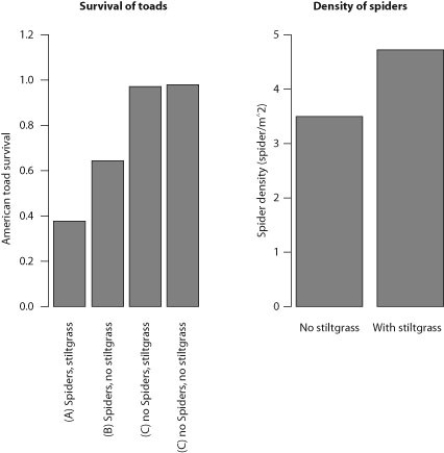 Source: DeVore, J. L., & Maerz, J. C. (2014) . Grass invasion increases top‐down pressure on an amphibian via structurally mediated effects on an intraguild predator. Ecology, 95(7) , 1724-1730.
-What do their results demonstrate about the interactions between the species that they studied?
A) Lycosid spiders are predators of American toads.
B) American toads are herbivores of Japanese stiltgrass.
C) American toads are predators of lycosid spiders.
D) Japanese stiltgrass is a pathogen of lycosid spiders.
Correct Answer:

Verified
Correct Answer:
Verified
Q15: In your backyard you overturn a large
Q16: A stonefly is an aquatic insect that
Q17: Which process represents a step in the
Q18: If an owl and a hawk both
Q19: Kudzu is a fast-growing vine that was
Q21: During ecological succession, the species composition of
Q22: Most plants have a variety of chemicals,
Q23: Which arrow shows nitrogen fixation? <img src="https://d2lvgg3v3hfg70.cloudfront.net/TB6039/.jpg"
Q24: A community is composed of<br>A) potentially interacting
Q25: What is an example of predation?<br>A) the