Multiple Choice
Water movement is important in urine formation in the kidneys. Urine is formed when the blood is filtered by the kidneys into kidney tubules. Three figures are presented here that relate to how the kidney tubules respond to the administration of the hormone vasopressin. The direction that water flows in these figures is from the kidney tubules back into the blood.
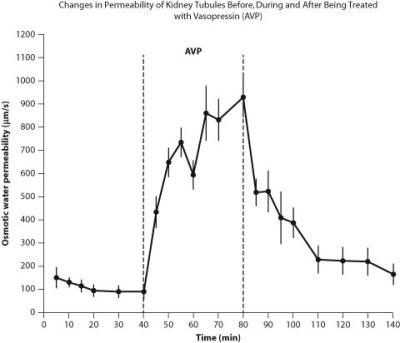 Figure A. Changes in permeability of tubules in the kidney in response to the hormone vasopressin (AVP) , which aids in osmoregulation.
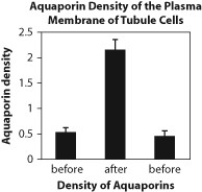 Figure B. Density of aquaporins in kidney tubule cells before, during, and after administration of vasopressin.
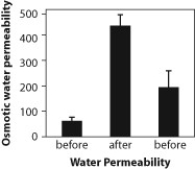 Figure C. Permeability of tissues to water before, during, and after administration of vasopressin.
-Based on the data from these figures, what do you expect the urine of a person to be like when vasopressin is having an effect on the kidney tubules?
A) The urine will be salty.
B) The urine will be dilute.
C) The urine will be concentrated.
D) There will be large volumes of urine.
Correct Answer:

Verified
Correct Answer:
Verified
Q42: The transfer of a phosphate group to
Q43: Which figure depicts an animal cell placed
Q44: Which of the following statements regarding diffusion
Q45: Certain cells that line the stomach synthesize
Q46: Cells acquire low-density lipoproteins (LDLs) by<br>A) diffusion.<br>B)
Q48: Aquaporins<br>A) allow water to cross the plasma
Q49: If placed in tap water, an animal
Q50: In the lab, you use a special
Q51: Bacterial production of the enzymes needed for
Q52: Which of the following statements regarding active