Multiple Choice
Water movement is important in urine formation in the kidneys. Urine is formed when the blood is filtered by the kidneys into kidney tubules. Three figures are presented here that relate to how the kidney tubules respond to the administration of the hormone vasopressin. The direction that water flows in these figures is from the kidney tubules back into the blood.
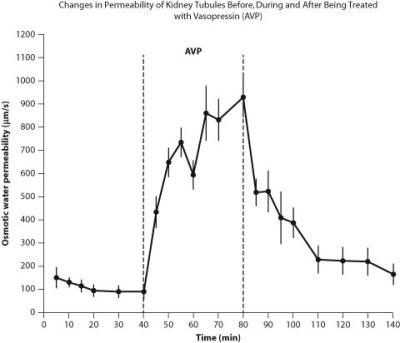 Figure A. Changes in permeability of tubules in the kidney in response to the hormone vasopressin (AVP) , which aids in osmoregulation.
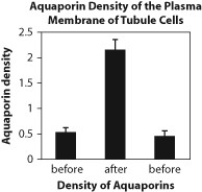 Figure B. Density of aquaporins in kidney tubule cells before, during, and after administration of vasopressin.
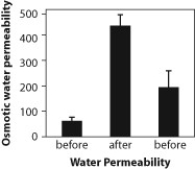 Figure C. Permeability of tissues to water before, during, and after administration of vasopressin.
-Using the data from the graphs and what you know about membranes and metabolic pathways, predict which of the following is the likely reason why actions of aquaporins in a membrane can change so rapidly.
A) The number of aquaporins in the membrane is constant, but the pores have to be activated.
B) Aquaporins are inserted into the membrane as needed.
C) Aquaporins are only in cells that need to be permeable to water.
D) Aquaporins use ATP to pump water across the membrane, and their action is limited by the metabolic pathways that produce ATP.
Correct Answer:

Verified
Correct Answer:
Verified
Q61: A group of single-cell organisms collected from
Q62: Which of the following processes can move
Q63: Lipase is an enzyme released by the
Q64: When an enzyme catalyzes a reaction<br>A) it
Q65: In the reaction A → B +
Q67: Which of the following direct energy transfers
Q68: All cells are enclosed by a plasma
Q69: Relaying a message from a membrane receptor
Q70: Living systems<br>A) violate the first law of
Q71: Anything that prevents ATP formation will most