Essay
Wild-type mice are adoptively transferred with naive CD4 T cells isolated from OT-II T-cell receptor transgenic mice. These OT-II T cells are specific for a peptide of the chicken ovalbumin protein (OVA) bound to MHC class II. After transfer, the OT-II cells rapidly disperse to all of the secondary lymphoid organs in the recipient mice. Half of the recipient mice are then given OVA protein dissolved in their drinking water, and the other half of the mice receive normal drinking water for 5 days. On the following day (day 6), lymphocytes from the spleen, the peripheral lymph nodes (LN), mesenteric lymph nodes (MLN), Peyer's patches (PP) and lamina propria (LP) are isolated and examined for the proportions of CD4 T cells in each organ expressing FoxP3. The results are shown in Figure. 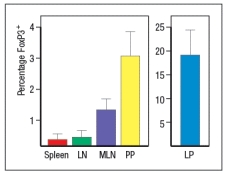
a) What is the conclusion from this experiment?
To investigate this further, dendritic cells are isolated from the spleen (spl-DC) or from the lamina propria of the small intestine (LP-DC). Each subset of dendritic cells is pulsed with the OVA protein, and then incubated with naive OT-II CD4 T cells for 5 days in the presence or absence of TGF- . The CD4 T cells are then examined for FoxP3 expression; the results are shown in Figure. 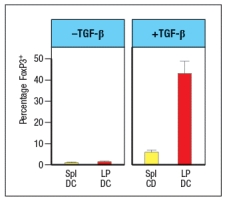
b) Why is TGF- added in this experiment?
c) What is the major difference between the splenic dendritic cells and those isolated from the lamina propria?
The CD4 T cells from the experiment above, in which the T cells were cultured for 5 days with OVA-pulsed splenic or lamina propria dendritic cells in the presence or absence of TGF- , were also assessed for their surface expression of the integrin 4 7.
d) Of the four groups of T cells shown in the graph, which ones would be expected to show high levels of 4 7?
Correct Answer:

Verified
a) A higher percentage of the naive OT-I...View Answer
Unlock this answer now
Get Access to more Verified Answers free of charge
Correct Answer:
Verified
View Answer
Unlock this answer now
Get Access to more Verified Answers free of charge
Q1: Vibrio cholerae causes an acute diarrheal illness
Q2: Mice lacking the poly Ig receptor (pIgR)
Q3: Oral inoculation with rotavirus, an intestinal pathogen,
Q5: Secretory IgA produced in the epithelium of
Q6: In a second experiment, the isolated
Q7: Infection of mice with the bacterial pathogen,
Q8: Oral tolerance to food antigens and immune
Q9: Reovirus is an enteric virus that
Q10: NOD proteins are intracellular sensors of infections
Q11: Purified CD4 T cells were stimulated