Multiple Choice
The following question(s) are based on information in Hopi E. Hoekstra, Kristen E. Drumm, and Michael W. Nachman, "Ecological Genetics of Adaptive Color Polymorphism in Pocket Mice: Geographic Variation in Selected and Neutral Genes," Evolution 58(6) , 2004: 1329-41. 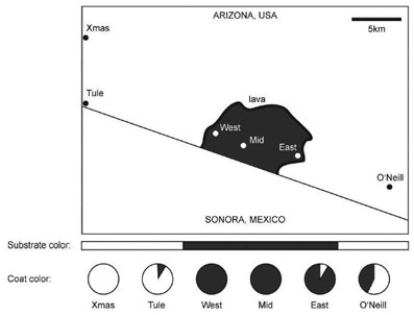
-Refer to the figure above. In their investigation of natural selection on Mc1r alleles (the gene that determines coat color) in Arizona pocket mice, Hoekstra et al. determined the frequency of the D and d alleles in each population. They also determined the frequency of alleles for two neutral mitochondrial DNA genes (genes that do not affect and are not linked to coat color) . Why did the researchers include the mitochondrial DNA genes as part of their experimental design?
A) Allele change for the neutral mitochondrial genes serves as an experimental group and gives information on any general background genetic difference among these populations.
B) Allele change for the neutral mitochondrial genes serves as a control and determines coat-color differences among these populations.
C) Allele change for the neutral mitochondrial genes serves as an experimental group and gives information on coat-color differences among these populations.
D) Allele change for the neutral mitochondrial genes serves as a control and gives information on any general background genetic difference among these populations.
E) None of the above answers applies.
Correct Answer:

Verified
Correct Answer:
Verified
Q4: If x indicates the fossils of two
Q6: Which of the following is a fitness
Q7: The same basic internal organs (kidneys, stomach,
Q9: A proficient engineer can easily design skeletal
Q10: Which of the pairs of plant structures
Q12: Similar gill pouches in embryos of a
Q13: A farmer uses triazine herbicide to control
Q14: Vestigial traits and neutral changes in DNA
Q16: After the drought of 1977, researchers hypothesized
Q48: The following questions refer to Figure 22.1,