Multiple Choice
Use the following information to answer the question(s) below.
Martin Wikelski and L. Michael Romero (Body size, performance, and fitness in Galápagos marine iguanas, Integrative and Comparative Biology 43 [2003]: 376-86) measured the snout-to-vent (anus) length of Galápagos marine iguanas and observed the percent survival of different-sized animals, all of the same age. The graph shows the log snout-vent length (SVL, a measure of overall body size) plotted against the percent survival of these different-size classes for males and females. 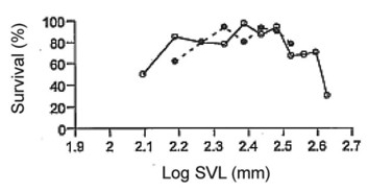
-Wikelski and Romero (2003) found that large marine iguanas had higher reproductive success than smaller iguanas did. However, the large iguanas were generally in poor body condition because they could not eat enough; at higher temperatures, their foraging efficiency improved, allowing them to eat more. Thus, Wikelski and Romero hypothesized that iguana size will ________ as global warming gradually increases air and water temperatures in the Galápagos Islands.
A) increase
B) decrease
C) stabilize around the mean body size
D) remain unchanged (it is not clear that body size increases fitness)
Correct Answer:

Verified
Correct Answer:
Verified
Q9: Cystic fibrosis is a genetic disorder in
Q10: <img src="https://d2lvgg3v3hfg70.cloudfront.net/TB3735/.jpg" alt=" Which of the
Q11: Use the following information to answer the
Q12: Use the following information to answer the
Q13: Genetic drift occurs in a population. Which
Q15: In a small population of alpine foxes,
Q16: A researcher wants to know if gene
Q18: Suppose 64 percent of a remote mountain
Q19: An earthquake decimates a ground-squirrel population, killing
Q45: In seedcracker finches from Cameroon, small- and