Multiple Choice
The table below shows units of wheat and cloth produced by each worker per day in both the countries.Table 20.1
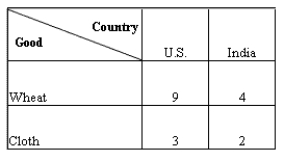
-The difference between absolute and comparative advantage is that:
A) absolute advantage refers to input cost, while comparative advantage refers to opportunity cost.
B) absolute advantage refers to opportunity cost, while comparative advantage refers to input cost.
C) absolute advantage is applicable only to individuals, and comparative advantage is applicable only to countries.
D) absolute advantage is applicable only to countries, and comparative advantage is applicable only to individuals.
E) absolute advantage is applicable to international trade, while comparative advantage applies to exchange of goods in the domestic market.
Correct Answer:

Verified
Correct Answer:
Verified
Q102: The table below shows the quantity demanded
Q103: The table below shows the quantity demanded
Q104: The figure given below shows the import
Q105: The data in the table below assumes
Q106: The table below shows the quantity demanded
Q107: Scenario 20.2<br>Suppose labor productivity differences are the
Q108: The table below shows the quantity demanded
Q110: The table below shows the quantity demanded
Q111: The table below shows units of wheat
Q112: The table below shows units of wheat