Multiple Choice
A box of mass m is pressed against (but is not attached to) an ideal spring of force constant k and negligible mass,compressing the spring a distance x.After it is released,the box slides up a frictionless incline as shown in the figure and eventually stops.If we repeat this experiment with a box of mass 2m 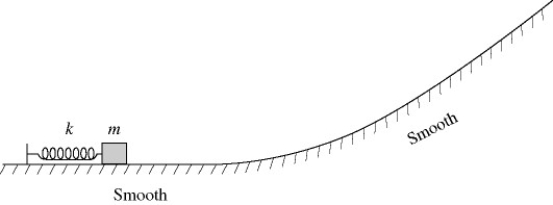
A) the lighter box will go twice as high up the incline as the heavier box.
B) just as it moves free of the spring, the lighter box will be moving twice as fast as the heavier box.
C) both boxes will have the same speed just as they move free of the spring.
D) both boxes will reach the same maximum height on the incline.
E) just as it moves free of the spring, the heavier box will have twice as much kinetic energy as the lighter box.
Correct Answer:

Verified
Correct Answer:
Verified
Q1: A heavy stone of mass m is
Q19: A series circuit consists of a 50-Hz
Q24: A ray of light consisting of blue
Q29: What is 0.205<sup>2/3</sup>,expressed to the proper number
Q34: An ice cube at 0°C is placed
Q41: You are standing in a moving bus,facing
Q518: A mass M is attached to an
Q520: The figure shows the graph of the
Q522: Three equal negative point charges are placed
Q526: In the figure a current of 6.0