Short Answer
The figure shows two vectors and , along with their magnitudes and directions. The vector is given by = - . 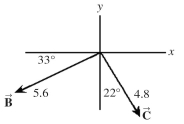 (a) What is the magnitude of vector ?
(b) What angle does vector make with the +x-axis?
Correct Answer:

Verified
Correct Answer:
Verified
Related Questions
Q1: A plane has an airspeed of 200
Q24: A player kicks a soccer ball in
Q38: A plane has an airspeed of 142
Q42: A hockey puck slides off the edge
Q108: The acceleration due to gravity on
Q110: The figure shows four vectors,
Q113: If <span class="ql-formula" data-value="\vec {
Q114: Vector <span class="ql-formula" data-value="\vec {
Q116: Two forces are acting on an object
Q117: Vectors <span class="ql-formula" data-value="\overrightarrow {