Multiple Choice
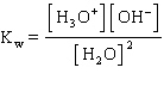
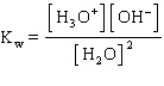
One water molecule can donate a proton to another in a process called ____; the equilibrium constant expression for this reaction is ____.
A) neutralization; ![One water molecule can donate a proton to another in a process called ____; the equilibrium constant expression for this reaction is ____. A) neutralization; B) autoionization; C) protonation; D) hydrolysis; E) autoionization; K<sub>w</sub> = [H<sub>3</sub>O<sup>+</sup>][OH<sup>-</sup>]](https://d2lvgg3v3hfg70.cloudfront.net/TB5061/11ea782d_fd7a_dbcb_bbd5_03a8e31609e2_TB5061_11.jpg)
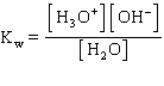
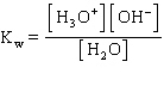
B) autoionization; ![One water molecule can donate a proton to another in a process called ____; the equilibrium constant expression for this reaction is ____. A) neutralization; B) autoionization; C) protonation; D) hydrolysis; E) autoionization; K<sub>w</sub> = [H<sub>3</sub>O<sup>+</sup>][OH<sup>-</sup>]](https://d2lvgg3v3hfg70.cloudfront.net/TB5061/11ea782d_fd7a_dbcc_bbd5_474058719102_TB5061_11.jpg)
C) protonation; ![One water molecule can donate a proton to another in a process called ____; the equilibrium constant expression for this reaction is ____. A) neutralization; B) autoionization; C) protonation; D) hydrolysis; E) autoionization; K<sub>w</sub> = [H<sub>3</sub>O<sup>+</sup>][OH<sup>-</sup>]](https://d2lvgg3v3hfg70.cloudfront.net/TB5061/11ea782d_fd7a_dbcd_bbd5_71a48fb9822a_TB5061_11.jpg)
D) hydrolysis; ![One water molecule can donate a proton to another in a process called ____; the equilibrium constant expression for this reaction is ____. A) neutralization; B) autoionization; C) protonation; D) hydrolysis; E) autoionization; K<sub>w</sub> = [H<sub>3</sub>O<sup>+</sup>][OH<sup>-</sup>]](https://d2lvgg3v3hfg70.cloudfront.net/TB5061/11ea782d_fd7a_dbce_bbd5_699d5bb5f02d_TB5061_11.jpg)
E) autoionization; Kw = [H3O+][OH-]
Correct Answer:

Verified
Correct Answer:
Verified
Q52: A Bronsted-Lowry acid is always<br>A) a highly
Q53: In a neutral polyprotic acid, the value
Q54: A solution is not neutral. Which one
Q55: Carboxylic acids have the formula<br>A) R-CH<sub>3</sub><br>B) R-CHO<br>C)
Q56: Which condition represents the most acidic solution?<br>A)
Q57: Methylamine, CH<sub>3</sub>NH<sub>2</sub>, acts as a weak base
Q59: If the hydrogen ion concentration of a
Q60: A solution of acetic acid (K<sub>a</sub> =
Q61: An acidic solution is diluted until [H<sub>3</sub>O<sup>+</sup>]
Q62: The larger the value of K<sub>a</sub><br>A) the