Essay
Williams,CPA intends to use probability-proportional-to-size sampling.He has properly selected and audited a sample of 100 accounts receivable from his client's population of 3000 accounts.He calculated a sampling interval of $5,000 and the tolerable misstatement for the account is $40,000.He has the following table available: 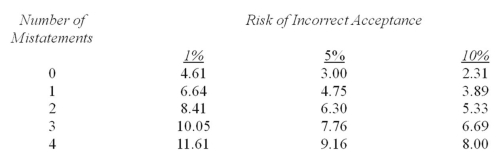 Williams also recalls that "basic precision" is equal to the appropriate reliability factor multiplied times the sampling interval.He wishes to accept a risk of incorrect acceptance of 10 percent.
He found that 97 of the 100 accounts in the sample were properly calculated.However,the following three errors existed: a.Calculate the projected misstatement.
b.Calculate the basic precision.
c.Calculate the incremental allowance.
d.Calculate the upper limit on misstatement.
e.Explain how the auditors would consider the results calculated above.
Correct Answer:

Verified
Correct Answer:
Verified
Q1: For which of the following populations would
Q3: Which statement is most proper for evaluating
Q4: The upper limit on misstatement in a
Q5: When no misstatements are identified in a
Q6: Which of the following statements is correct
Q7: In a PPS sample,the most likely misstatement
Q8: When using probability-proportional-to-size sampling,the actual total misstatement
Q9: Increasing the expected misstatement for a probability-proportional-to-size
Q10: In a probability-proportional-to-size sample with a sampling
Q11: Assume the following relating to a PPS