Essay
Dr. Phillips is a cognitive-developmental psychologist who studies how children learn mathematical principles. His current interest is in studying how children learn multiplication. He recruits 54 second-graders who have not yet learned how to multiply numbers to participate in his study. He is curious as to whether different teaching styles lead to better mastery of the subject. One condition (A) involves having students read a chapter on multiplication from their textbook. One condition (B) involves having students watch a video of cartoon characters explaining multiplication. One condition (C) involves having students being taught multiplication by a teacher. One condition (D) involves having students being taught multiplication by a fourth-grader. In all conditions, participants spend 30 minutes learning the fundamentals of multiplication and are then given the same 15-question multiplication test. The number of questions answered correctly is recorded. The data are below.
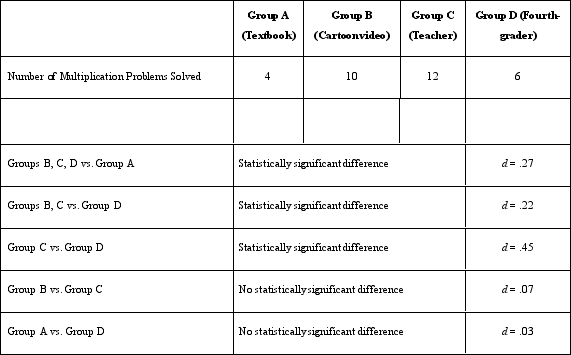
Name two ways that Dr. Phillips could avoid selection threat when he is assigning participants to conditions and explain why each of these methods avoids selection threat.
Correct Answer:

Verified
In each response,students should provide...View Answer
Unlock this answer now
Get Access to more Verified Answers free of charge
Correct Answer:
Verified
View Answer
Unlock this answer now
Get Access to more Verified Answers free of charge
Q27: When interrogating the construct validity of the
Q28: Dr. Lonsbary is a cognitive psychologist who
Q29: Dr. Dormeur studies sleep and sleep disorders.
Q30: Name three disadvantages of within-groups designs.
Q31: Using a matched-group design is especially important
Q33: is used to control order effects in
Q34: Dr. Lonsbary is a cognitive psychologist who
Q35: A variable that the researcher controls is
Q36: Dr. Lonsbary is a cognitive psychologist who
Q37: Dr. Lonsbary is a cognitive psychologist who