Essay
Dr. Phillips is a cognitive-developmental psychologist who studies how children learn mathematical principles. His current interest is in studying how children learn multiplication. He recruits 54 second-graders who have not yet learned how to multiply numbers to participate in his study. He is curious as to whether different teaching styles lead to better mastery of the subject. One condition (A) involves having students read a chapter on multiplication from their textbook. One condition (B) involves having students watch a video of cartoon characters explaining multiplication. One condition (C) involves having students being taught multiplication by a teacher. One condition (D) involves having students being taught multiplication by a fourth-grader. In all conditions, participants spend 30 minutes learning the fundamentals of multiplication and are then given the same 15-question multiplication test. The number of questions answered correctly is recorded. The data are below.
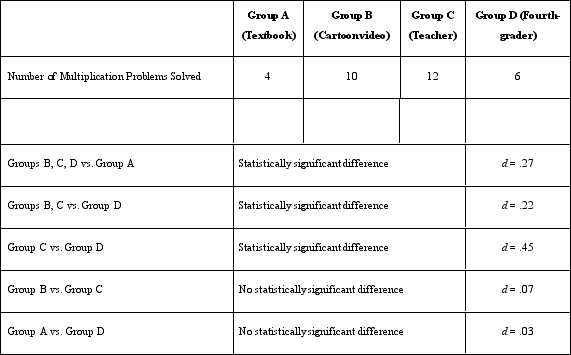
Based on the results of his study, Dr. Phillips hopes to make a causal statement. Explain how his study does or does not meet the three rules of causation.
Correct Answer:

Verified
The three rules for causation are covari...View Answer
Unlock this answer now
Get Access to more Verified Answers free of charge
Correct Answer:
Verified
View Answer
Unlock this answer now
Get Access to more Verified Answers free of charge
Q6: What is the difference between a posttest-only
Q7: Which of the following phrases describes a
Q8: Dr. Lonsbary is a cognitive psychologist who
Q9: In the study depicted in the figure
Q10: All of the following are advantages of
Q12: Dr. Lonsbary is a cognitive psychologist who
Q13: Generally, what is the main priority for
Q14: Dr. Phillips is a cognitive-developmental psychologist who
Q15: Practice effects and carryover effects are examples
Q16: Random selection enhances validity and random assignment