Multiple Choice
Dr. Finkel is a social psychologist who studies romantic relationships. Several researchers have found that there is a link between income and marital satisfaction (e.g., Dakin & Wampler, 2012) . Dr. Finkel is curious as to whether there is a causal link between the two variables, such that having a higher income causes higher levels of marital satisfaction. He is confident that he cannot reasonably or ethically manipulate people's income level, so he decides to use a multivariate design. He is also curious as to whether there is a causal link between these two variables or if two other variables (number of arguments and life satisfaction) can explain the relationship. He measures his three variables in a sample of 124 married couples recruited from a local community center. Below are his results.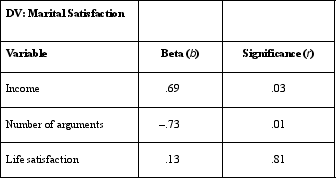
Which of the following can be concluded based on the results of Dr. Finkel's study?
A) As the number of arguments a couple has increases, their marital satisfaction increases as well, controlling for income but not life satisfaction.
B) The relationship between life satisfaction and marital satisfaction has the weakest effect size of all of the results.
C) The beta for the relationship between life satisfaction and marital satisfaction is significantly different than zero.
D) Income is a stronger predictor of martial satisfaction than either the number of arguments or life satisfaction.
Correct Answer:

Verified
Correct Answer:
Verified
Q3: Cross-lag correlations are NOT helpful for answering/addressing
Q4: Dr. Farah is an educational psychologist who
Q5: The pattern and parsimony approach to causation
Q6: Dr. O'Toole is a counseling psychologist who
Q7: Dr. Finkel is a social psychologist who
Q9: Explain why longitudinal designs can help researchers
Q10: A researcher has examined a variety of
Q11: Dr. Farah is an educational psychologist who
Q12: Which popular media headline does NOT suggest
Q13: Dr. Cheong is a clinical psychologist who