Multiple Choice
Titan's thick atmosphere (see the image below) is hypothesized to have been created when ultraviolet photons broke apart methane molecules,ultimately creating the observed smog-like conditions.This process,though,would likely remove all of the atmospheric methane in roughly 10 million years,yet we still see its presence today.How can this be? 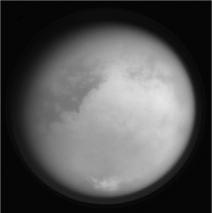
A) Cometary impacts periodically bring new methane to Titan.
B) Ethane rains down out of the atmosphere, combines with surface rocks, and creates new methane.
C) Infrared photons give atmospheric molecules enough energy to recombine into methane.
D) Volcanoes on Titan periodically release new methane into the atmosphere.
Correct Answer:

Verified
Correct Answer:
Verified
Q9: Phobos and Deimos,the two moons of Mars,are
Q16: The mass of all the known asteroids
Q54: How can moons be more geologically active
Q55: Why has planet formation essentially stopped in
Q56: The chronological description of an asteroidal fragment
Q57: The nucleus of the typical comet is
Q59: Examine the image below.Why does a comet
Q63: In 1994,dozens of fragments of Comet Shoemaker-Levy
Q64: Comet nuclei,absent their tails,are very dark because<br>A)
Q64: Why is the asteroid Ceres classified as