Essay
An artificial cell consisting of an aqueous solution enclosed in a selectively permeable membrane is immersed in a beaker containing a different solution. The membrane is permeable to water and to the simple sugars glucose and fructose but impermeable to the disaccharide sucrose.
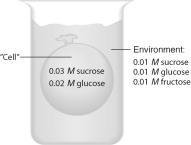
(A)Draw solid arrows to indicate the net movement of solutes into and/or out of the cell.
(B)Is the solution outside the cell isotonic, hypotonic, or hypertonic?
(C)Draw a dashed arrow to show the net osmotic movement of water, if any.
(D)Will the artificial cell become more flaccid, more turgid, or stay the same?
(E)Eventually, will the two solutions have the same or different solute concentrations?
Correct Answer:

Verified
(A)

(B) The solution outside is hypot...View Answer
Unlock this answer now
Get Access to more Verified Answers free of charge
Correct Answer:
Verified
(B) The solution outside is hypot...
View Answer
Unlock this answer now
Get Access to more Verified Answers free of charge
Q9: The solutions in the two arms of
Q61: When biological membranes are frozen and then
Q63: Use the diagram of the U-tube in
Q64: Which of these are attached to the
Q65: In most cells, there are electrochemical gradients
Q66: For the following questions, match the labeled
Q69: The following information should be used to
Q71: If a membrane protein in an animal
Q72: What kinds of molecules pass through a
Q72: When a plant cell, such as one