Short Answer
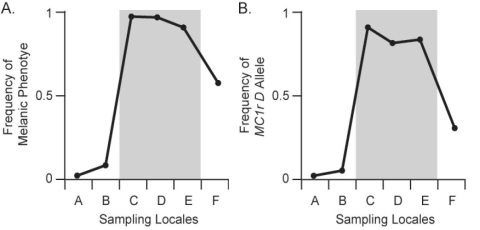
Figure 24.2
The distribution of pocket-mouse coat colors in several Arizona populations is associated with substrate color.Some populations live on light-colored granite substrate,and others live on dark volcanic rock.In Figure 24.2,chart A shows the frequency of the melanic (dark)coat phenotype across six populations.Populations C,D,and E live on dark volcanic rock;populations A,B,and F live on light-colored granite.Chart B shows the frequency of the Melanocortin-1 receptor (Mc1r)allele across these populations.The Mc1r alleles,D and d,differ by four amino acids;mice with DD and Dd genotypes have dark coats,whereas mice with dd genotype are light colored.Which of the following statements best interprets the results shown in charts A and B?
A)Frequency of the D allele is closely associated with the melanic phenotype,but is unrelated to the presence of dark substrate color.
B)Frequency of the D allele is not associated with the melanic phenotype,but is associated with the presence of dark substrate color.
C)Frequency of the D allele is closely associated with both the melanic phenotype and the presence of dark substrate color.
D)Frequency of the D allele is associated neither with the melanic phenotype nor with the presence of dark substrate color.
E)Frequency of the D allele does not vary.
Correct Answer:

Verified
Correct Answer:
Verified
Q7: Which of the following statements is an
Q9: Evolution by natural selection changes the population
Q17: Which of these conditions are always true
Q19: Fishers typically target the largest,and thus,oldest fish.Given
Q20: Which of the following is a fitness
Q20: Which of the following is the best
Q21: Many crustaceans (e.g.,lobsters,shrimp,and crayfish)use their tails to
Q25: Your text discusses the evolution of antibiotic-resistant
Q26: According to the theory of evolution by
Q27: If the population is maintained on media