Multiple Choice
Babies born with low birth weights (less than 2500 grams) are at an increased risk for many infant diseases. Researchers in North Carolina collected data to see what variables may influence the birth weight (in grams) of a child, including whether the mother drank alcohol during pregnancy, whether the mother smoked during pregnancy, the mother's age (years) , the gestation of the pregnancy (number of weeks from conception until birth) , the mother's race, the length of the birth (hours) , and several others. The plot below summarizes some of the variables measured. 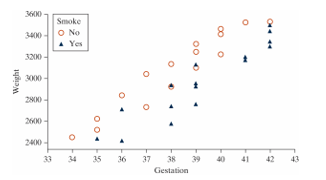
-Does the association between gestation period and birthweight appear to depend on smoking status?
A) Yes, since the regression line for non-smokers is higher than the regression line for smokers.
B) Yes, since the regression line for non-smokers would have a higher y-intercept than the regression line for smokers.
C) No, since the regression line for non-smokers and the regression line for smokers have similar slopes.
D) No, since the sample sizes of smokers and non-smokers are similar.
Correct Answer:

Verified
Correct Answer:
Verified
Q22: The following scatterplot displays the finish time
Q23: Annual measurements of the number of powerboat
Q24: The least squares regression line minimizes the
Q25: Data from gapminder.org on 184 countries was
Q26: It is commonly expected that as a
Q28: Annual measurements of the number of powerboat
Q29: How is the number of pages in
Q30: Are people with bigger brains more intelligent?
Q31: Annual measurements of the number of powerboat
Q32: It is commonly expected that as a