Multiple Choice
Civil engineers often use the straight-line equation,  =
 +
 x, to model the relationship between the mean shear strength of masonry joints and precompression stress, x. To test this theory, a series of stress tests were performed on solid bricks arranged in triplets and joined with mortar. The precompression stress was varied for each triplet and the ultimate shear load just before failure (called the shear strength) was recorded. The stress results for n = 7 triplet tests is shown in the accompanying table followed by a SAS printout of the regression analysis.
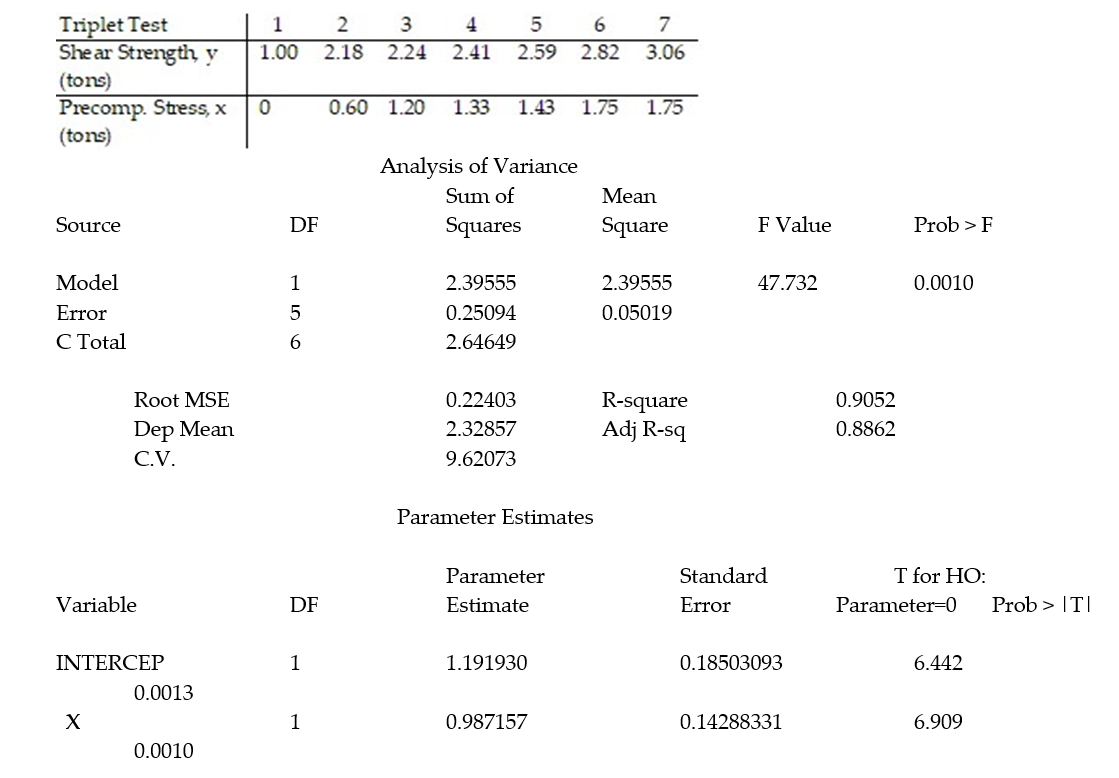
- Give a practical interpretation of the estimate of the y-intercept of the least squares line.
A) For a triplet test with a precompression stress of 0 tons, we estimate the shear strength of the joint to increase 1.19 tons.
B) There is no practical interpretation since a triplet test with a precompression stress of 0 tons is outside the range of the sample data.
C) For a triplet test with a precompression stress of 0 tons, we estimate the shear strength of the joint to be 1.19 tons.
D) For every 1 ton increase in precompression stress, we estimate the shear strength of the joint to increase by 0.987 ton.
Correct Answer:

Verified
Correct Answer:
Verified
Q78: Calculate the linear correlation coefficient for the
Q79: A manufacturer of boiler drums wants to
Q80: Civil engineers often use the straight-line equation,
Q81: A manager wishes to determine the relationship
Q82: The coefficient of correlation between x and
Q84: The regression line for the given data
Q85: The following data represent the living situation
Q86: Use the linear correlation coefficient given to
Q87: Construct a scatter diagram for the data.<br>-Five
Q88: In a study of feeding behavior, zoologists