Multiple Choice
The office is visited by a 43-year-old guy with a history of HIV infection who is not adhering to highly active antiretroviral medication as a result of years of memory loss and cognitive impairment. The patient struggles with speaking, concentration, and attention. He has been more indifferent and sluggish during the past few months. He has fallen several times in the recent past due to balance issues. The patient hasn't had a headache, tremor, blurred vision, fever, nausea, or incontinence. His brother has a history of severe intellectual disability and epilepsy. The patient has an 18/30 Mini-Mental State Examination score and is emotionally dulled. He also struggles with fine motor skills and postural instability. Noncontrast head CT scan reveals diffuse cortical atrophy with some enlargement of the ventricles, as shown in the exhibits. 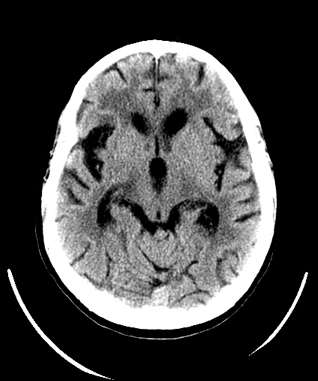
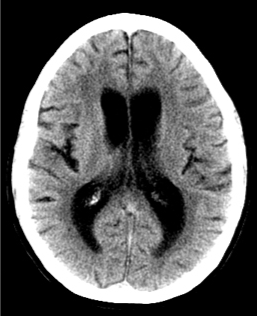 This patient's condition can be best described as which of the following?
A) Communicating hydrocephalus
B) Hydrocephalus ex-vacuo
C) Lissencephaly
D) Noncommunicating hydrocephalus
E) Pseudotumor cerebri
F) Transtentorial (uncal) herniation
Correct Answer:

Verified
Correct Answer:
Verified
Q402: A 59-year-old man comes to the office
Q403: A 67-year-old man comes to the physician
Q404: A 5-year-old girl is brought to the
Q405: A 74-year-old man presented to the emergency
Q406: A 72-year-old woman is brought to the
Q408: A 12-year-old girl is brought to the
Q409: In young and otherwise healthy patients who
Q410: A 52-year-old woman comes to the emergency
Q411: A 22-year-old man comes to the emergency
Q412: A 55-year-old man is found unresponsive on