Multiple Choice
Passage
Nitrogen is extremely cold in its liquid phase. It is used in the cryopreservation of small tissue samples and in cryosurgery to freeze and destroy diseased tissues. Liquid nitrogen can be produced from nitrogen gas using the Hampson-Linde cycle (Figure 1) .
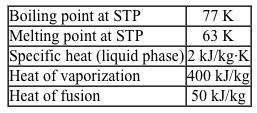
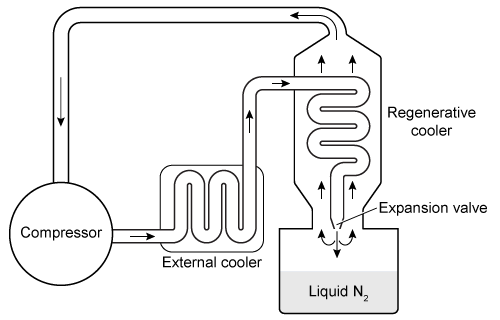 Figure 1 Hampson-Linde cycle apparatus used to liquefy nitrogenThe cycle begins by compressing nitrogen gas and forcing it through a coil in an external cooler that contains dry ice. The gas proceeds to a heat exchanger, where it cools further due to the countercurrent heat exchange with colder nitrogen gas returning from a later stage of the cycle; this process is known as regenerative cooling. The gas is subsequently forced through a narrow valve, where it expands and cools significantly upon exiting. As a result, a portion of the gas becomes liquefied.The temperature change of the gas exiting the valve is described by the Joule-Thomson effect, which occurs without heat transfer with the surroundings. Finally, the liquefied nitrogen is collected, and the remaining gas is sent through the regenerative cooler back to the compressor to reenter the cycle. The physical properties of nitrogen are given in Table 1.Table 1 Thermal Properties of Nitrogen
-Based on the passage, a feature of the Joule-Thomson effect is that it occurs:
A) isothermally.
B) adiabatically.
C) isochorically.
D) isobarically.
Correct Answer:

Verified
Correct Answer:
Verified
Q113: Passage<br>Ultrasound is a technique that uses the
Q114: Passage<br>Black holes have played an important part
Q115: A 10-kg block is suspended in air
Q116: Which of the following graphs best illustrates
Q117: The absolute temperature of ideal gas molecules
Q119: Relative to the angle of incidence, how
Q120: The band pattern produced by light passing
Q121: That the spherical aberration of a converging
Q122: Passage<br>Osteoporosis is a degenerative bone condition in
Q123: <img src="https://d2lvgg3v3hfg70.cloudfront.net/MD0008/.jpg" alt=" A flask with