Multiple Choice
Passage
Cable theory is a mathematical model used to calculate currents and voltages along and across axon membranes. The model treats small sections of the membrane as the resistor-capacitor circuit shown in Figure 1. An electric neuronal signal enters the circuit through the input node. A portion of the signal remains inside the axon and continues to the next section of membrane via Output 1, and the rest of the signal exits to the extracellular fluid via Output 2.
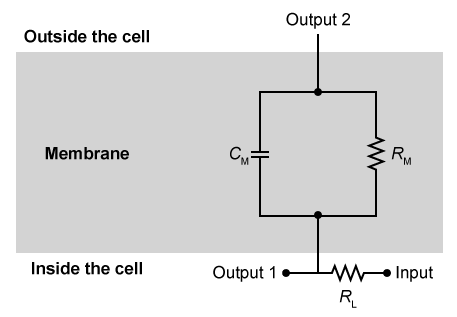 Figure 1 Circuit unit used to model axon membranesResearchers studied cable theory by recreating the circuit in Figure 1 using a 2 μF capacitor for CM, a 200 Ω resistor for RM, and a 1,000 Ω resistor for RL. The researchers sent an electrical signal through the input and discovered that the capacitor acted as a resistor whose resistance varied with the signal's frequency, as shown in Figure 2.
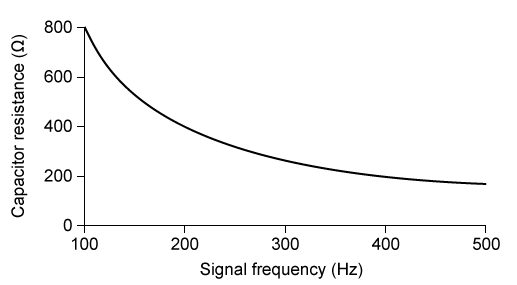 Figure 2 Capacitor equivalent resistance vs. signal frequency for CM
Adapted from Tuckwell H, Introduction to Theoretical Neurobiology 2006 SIAM.
-At 200 Hz, the current in CM is 0.7 A. What is the current in RM?
A) 0.35 A
B) 0.70 A
C) 1.4 A
D) 2.8 A
Correct Answer:

Verified
Correct Answer:
Verified
Q168: <img src="https://d2lvgg3v3hfg70.cloudfront.net/MD0008/.jpg" alt=" Four charged particles
Q169: Passage<br>In the event of end-stage heart failure,
Q170: Which of the following color transitions best
Q171: Passage<br>A student performed an experiment to determine
Q172: Passage<br>A student performed an experiment to determine
Q174: Passage<br>When present in the bloodstream above a
Q175: Passage<br>The electric capacitance of biological tissues serves
Q176: Passage<br>Cable theory is a mathematical model used
Q177: Performing a medical examination assessing the conduction
Q178: Passage<br>For a person with perfect vision, light