Multiple Choice
Passage
Cable theory is a mathematical model used to calculate currents and voltages along and across axon membranes. The model treats small sections of the membrane as the resistor-capacitor circuit shown in Figure 1. An electric neuronal signal enters the circuit through the input node. A portion of the signal remains inside the axon and continues to the next section of membrane via Output 1, and the rest of the signal exits to the extracellular fluid via Output 2.
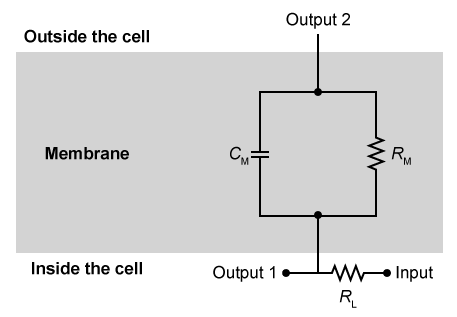 Figure 1 Circuit unit used to model axon membranesResearchers studied cable theory by recreating the circuit in Figure 1 using a 2 μF capacitor for CM, a 200 Ω resistor for RM, and a 1,000 Ω resistor for RL. The researchers sent an electrical signal through the input and discovered that the capacitor acted as a resistor whose resistance varied with the signal's frequency, as shown in Figure 2.
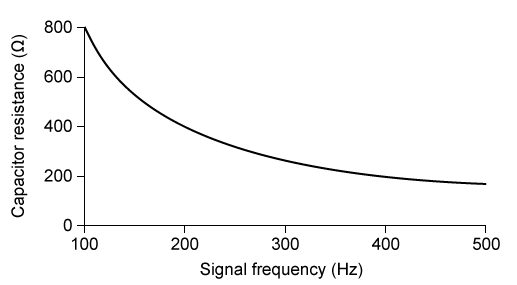 Figure 2 Capacitor equivalent resistance vs. signal frequency for CM
Adapted from Tuckwell H, Introduction to Theoretical Neurobiology 2006 SIAM.
-To test the integrity of the capacitor, researchers maintained a voltage of 50 mV across the parallel portion of the circuit for several minutes. During this time, how much energy was stored in the capacitor?
A) 2.5 × 10⁻⁹ J
B) 5.0 × 10⁻⁹ J
C) 5.0 × 10⁻⁸ J
D) 1.0 × 10⁻⁷ J
Correct Answer:

Verified
Correct Answer:
Verified
Q97: Which of the following changes will increase
Q98: Passage<br>In mass spectrometry, a sample's molecules are
Q99: Thin-film interference is observed when polychromatic light
Q100: Passage<br>A student performed an experiment to determine
Q101: The resistance of an object acting as
Q103: A circuit is constructed from two voltage
Q104: Passage<br>During deep underwater dives, scuba divers must
Q105: Passage<br>The effects of gravity are effectively negated
Q106: Passage<br>The electric capacitance of biological tissues serves
Q107: Passage<br>The flow of blood through the human