Multiple Choice
Passage
Sound waves propagate through many conducting structures in the ear before they are transduced into neuronal signals. When sound waves reach the fluid-filled cochlea, they are detected by hair cells lining the basilar membrane. The cochlear spiral can be modeled as a resonator system because each section of the basilar membrane is sensitive to a specific frequency (Figure 1) .
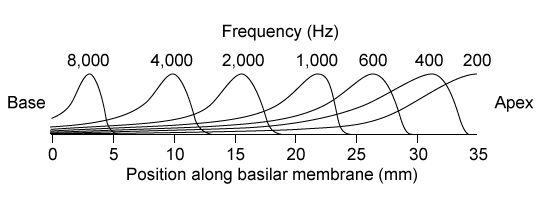 Figure 1 Amplitude pattern of the basilar membrane for different frequenciesPresbycusis (age-related hearing loss) results from a combination of factors that lessens an individual's mechanical and/or neurological sensitivity to sound. Pure tone audiometry (PTA) is used to determine an individual's ability to detect different sound frequencies and can be used to evaluate presbycusis. A "pure" tone is characterized by a single sinusoidal waveform. An audiogram plots the relative intensity required of a given frequency to be detected by the individual (Figure 2) .
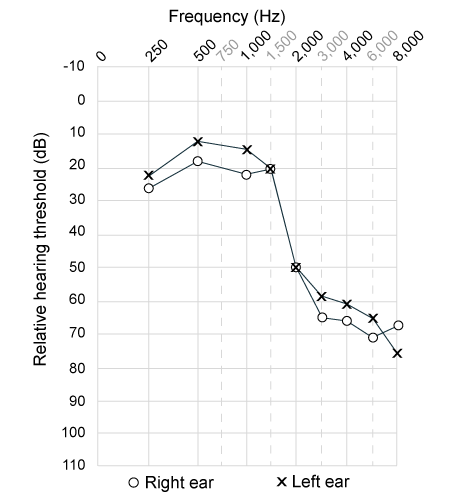 Figure 2 Audiogram of an elderly patient exhibiting presbycusis
-The earliest stethoscope was simply a wooden pipe open at both ends. The fundamental frequency of a 0.25-m stethoscope will cause resonance at approximately what distance along the basilar membrane from its base? (Note: Use 350 m/s for the speed of sound in air.)
A) 7 mm
B) 16 mm
C) 25 mm
D) 32 mm
Correct Answer:

Verified
Correct Answer:
Verified
Q105: Passage<br>The effects of gravity are effectively negated
Q106: Passage<br>The electric capacitance of biological tissues serves
Q107: Passage<br>The flow of blood through the human
Q108: Passage<br>A traumatic brain injury (TBI) is a
Q109: Which of the following will occur if
Q111: A dielectric material is introduced into the
Q112: Atmospheric pressure on a distant planet causes
Q113: Passage<br>Ultrasound is a technique that uses the
Q114: Passage<br>Black holes have played an important part
Q115: A 10-kg block is suspended in air