Multiple Choice
Passage
Sound waves propagate through many conducting structures in the ear before they are transduced into neuronal signals. When sound waves reach the fluid-filled cochlea, they are detected by hair cells lining the basilar membrane. The cochlear spiral can be modeled as a resonator system because each section of the basilar membrane is sensitive to a specific frequency (Figure 1) .
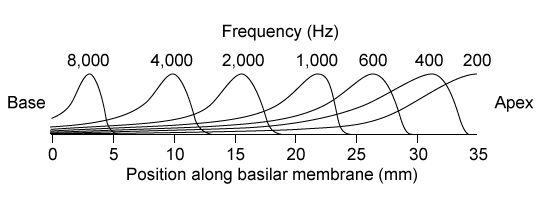 Figure 1 Amplitude pattern of the basilar membrane for different frequenciesPresbycusis (age-related hearing loss) results from a combination of factors that lessens an individual's mechanical and/or neurological sensitivity to sound. Pure tone audiometry (PTA) is used to determine an individual's ability to detect different sound frequencies and can be used to evaluate presbycusis. A "pure" tone is characterized by a single sinusoidal waveform. An audiogram plots the relative intensity required of a given frequency to be detected by the individual (Figure 2) .
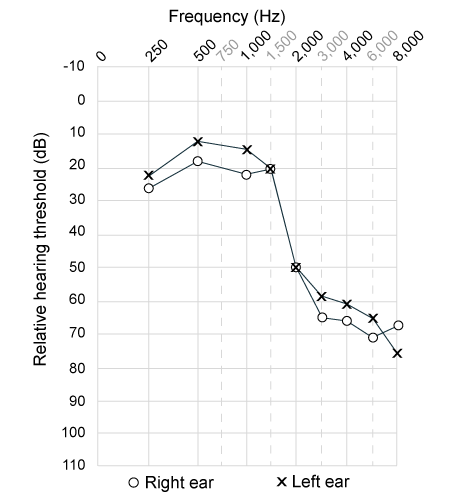 Figure 2 Audiogram of an elderly patient exhibiting presbycusis
-In Figure 2, how does the hearing threshold intensity at 1,500 Hz compare to the threshold intensity at 2,000 Hz?
A) It is 30 times less intense.
B) It is 30 times more intense.
C) It is 1,000 times less intense.
D) It is 1,000 times more intense.
Correct Answer:

Verified
Correct Answer:
Verified
Q56: A cannonball is launched at a speed
Q57: Passage<br>During deep underwater dives, scuba divers must
Q58: The electric force generated by two point
Q59: Passage<br>Positron emission tomography (PET) is a medical
Q60: Passage<br>In mass spectrometry, a sample's molecules are
Q62: Passage<br>The electric capacitance of biological tissues serves
Q63: Passage<br>The flow of blood through the human
Q64: Passage<br>Hydrostatic weighing is a technique used to
Q65: In which of the following processes does
Q66: A monoatomic ideal gas is sealed within