Multiple Choice
Passage
Solid-phase peptide synthesis is normally carried out on a resin bathed multiple times in dimethylformamide (DMF) -a toxic, polar, aprotic solvent-which poses an environmental problem because a large amount of toxic solvent waste is created. Cyclic carbonates such as propylene carbonate (PC) and ethylene carbonate (EC) are nontoxic, polar, aprotic solvents that could be used as an alternative to DMF.Compounds 1 and 2 are modified L-amino acids. They were coupled to form Compound 3, a dipeptide, which was then deprotected to yield Compound 4 (Figure 1) .
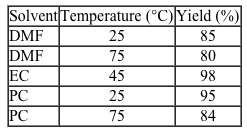
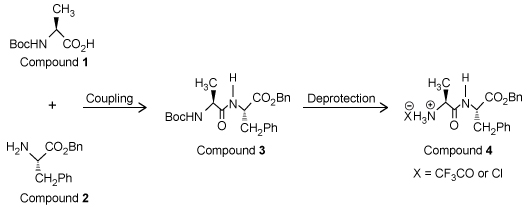 Figure 1 Synthesis of Compound 4To determine the effect that solvent type and temperature have on the synthesis of this peptide, the nontoxic solvents PC and EC as well as the toxic solvent DMF were each used in separate syntheses of Compound 4 at different temperatures. The reaction solvent was also used to rinse the resin. Table 1 shows the results of these syntheses.Table 1 Results from the Synthesis of Compound 4
 The successful synthesis of Compound 4 using nontoxic solvents encouraged researchers to pursue the synthesis of a larger, biologically active peptide. Bradykinin, a vasodilator containing nine amino acids (Arg-Pro-Pro-Gly-Phe-Ser-Pro-Phe-Arg) , was synthesized using the same solid-state peptide synthesis protocol used to synthesize Compound 4. Separate syntheses were done using either DMF or PC, and the purity of bradykinin from each synthesis was analyzed by high-performance liquid chromatography (HPLC) (Figure 2) .In each chromatogram, peak 1 has the same retention time as commercially obtained bradykinin, and the other peaks correspond to impurities. In chromatogram A, the impurity has a similar retention time to the product peak whereas the impurity peaks in chromatogram B have distinct retention times compared to the product peak.
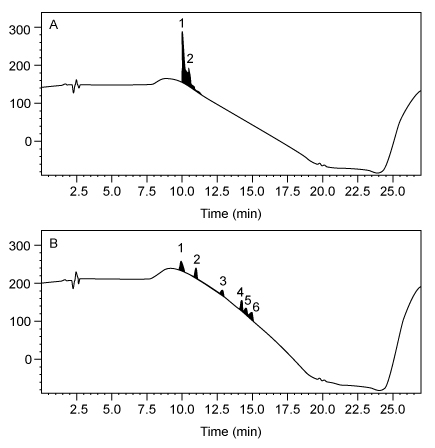 Figure 2 HPLC of synthetic bradykinin: (A) synthesis in DMF; (B) synthesis in PC
Adapted from S. B. Lawrenson et al., "The greening of peptide synthesis." Green Chem. ©2017 The Royal Society of Chemistry.
-What is the byproduct of the formation of Compound 3 described in the passage?
A) H2O; peptide bond formation is a dehydration reaction.
B) H2O; peptide bond formation is a hydrolysis reaction.
C) CO2; peptide bond formation is a decarboxylation reaction.
D) CO2; peptide bond formation is a coupling reaction.
Correct Answer:

Verified
Correct Answer:
Verified
Q28: Passage<br>Fatty acids (FAs) are lipids that play
Q29: A linear five-carbon ketone has a boiling
Q30: Passage<br>A limited number of cellular functions exist
Q31: Passage<br>Two key ingredients found in many soaps
Q32: What is the correct systematic name for
Q34: Passage<br>Aldehydes are organic compounds encountered in everyday
Q35: Triacylglycerols A and B are shown below.
Q36: The reaction below was performed under thermodynamic
Q37: Passage<br>High blood pressure, or hypertension, is a
Q38: Passage<br>A limited number of cellular functions exist