Multiple Choice
Passage
Solid-phase peptide synthesis is normally carried out on a resin bathed multiple times in dimethylformamide (DMF) -a toxic, polar, aprotic solvent-which poses an environmental problem because a large amount of toxic solvent waste is created. Cyclic carbonates such as propylene carbonate (PC) and ethylene carbonate (EC) are nontoxic, polar, aprotic solvents that could be used as an alternative to DMF.Compounds 1 and 2 are modified L-amino acids. They were coupled to form Compound 3, a dipeptide, which was then deprotected to yield Compound 4 (Figure 1) .
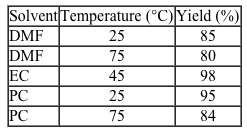
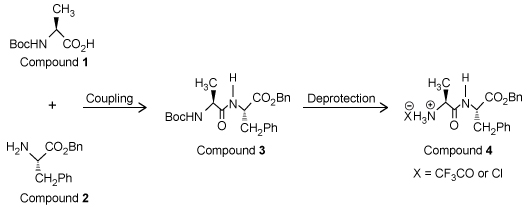 Figure 1 Synthesis of Compound 4To determine the effect that solvent type and temperature have on the synthesis of this peptide, the nontoxic solvents PC and EC as well as the toxic solvent DMF were each used in separate syntheses of Compound 4 at different temperatures. The reaction solvent was also used to rinse the resin. Table 1 shows the results of these syntheses.Table 1 Results from the Synthesis of Compound 4
 The successful synthesis of Compound 4 using nontoxic solvents encouraged researchers to pursue the synthesis of a larger, biologically active peptide. Bradykinin, a vasodilator containing nine amino acids (Arg-Pro-Pro-Gly-Phe-Ser-Pro-Phe-Arg) , was synthesized using the same solid-state peptide synthesis protocol used to synthesize Compound 4. Separate syntheses were done using either DMF or PC, and the purity of bradykinin from each synthesis was analyzed by high-performance liquid chromatography (HPLC) (Figure 2) .In each chromatogram, peak 1 has the same retention time as commercially obtained bradykinin, and the other peaks correspond to impurities. In chromatogram A, the impurity has a similar retention time to the product peak whereas the impurity peaks in chromatogram B have distinct retention times compared to the product peak.
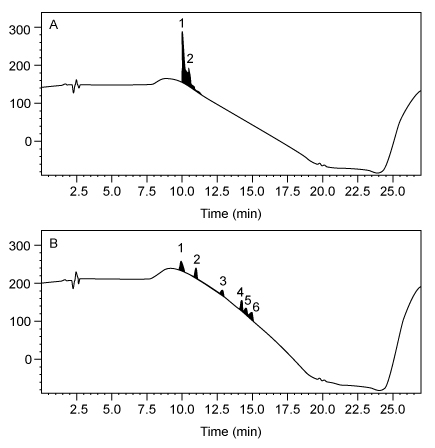 Figure 2 HPLC of synthetic bradykinin: (A) synthesis in DMF; (B) synthesis in PC
Adapted from S. B. Lawrenson et al., "The greening of peptide synthesis." Green Chem. ©2017 The Royal Society of Chemistry.
-A peptide bond is formed in bradykinin synthesis when the amino group of arginine reacts with:
A) an anhydride group.
B) a carboxyl group.
C) an amide group.
D) a hydroxyl group.
Correct Answer:

Verified
Correct Answer:
Verified
Q181: What structure is equivalent to Compound 1
Q182: The solutes in an aqueous reaction mixture
Q183: Passage<br>The protozoan Euglena gracilis expresses glycosyltransferases (enzymes
Q184: Passage<br>Fatty acids (FAs) are lipids that play
Q185: What is the product when (2R,3R)-2-bromo-3-methylpentane is
Q186: Passage<br>Hemophilia B is a blood clotting disorder
Q188: Passage<br>Two key ingredients found in many soaps
Q189: Passage<br>The cryptophycins, isolated from cyanobacteria, are a
Q190: The experimental data obtained when a chiral
Q191: Passage<br>The protozoan Euglena gracilis expresses glycosyltransferases (enzymes