Multiple Choice
Passage
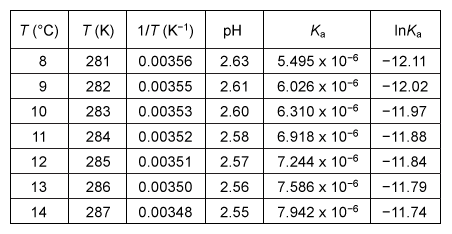
Students conducted an experiment to determine the changes in enthalpy ΔH°, entropy ΔS°, and Gibbs free energy ΔG° resulting from the dissociation of acetic acid (CH3COOH) in water. The students first determined the acid dissociation constant Ka for the reaction by measuring the pH of a 1 M acetic acid solution at various temperatures over a narrow range of less than 10 °C.To perform the pH measurements, the acetic acid solution was initially cooled to 0 °C using an ice bath and then warmed with gentle heating to room temperature with continuous stirring. The pH was recorded at intervals of 1 °C. From the pH data, the value of Ka at each temperature T was calculated. The experimental results over the selected temperature range are shown in Table 1.Table 1 Student Data for the pH and Ka of Acetic Acid with Increasing Temperature
 To evaluate ΔH° and ΔS°, the students constructed a van 't Hoff plot (Figure 1) , which is a graph of the natural log of the dissociation constant (ln Ka) vs. the reciprocal absolute temperature (1/T) .
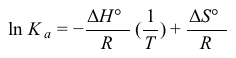
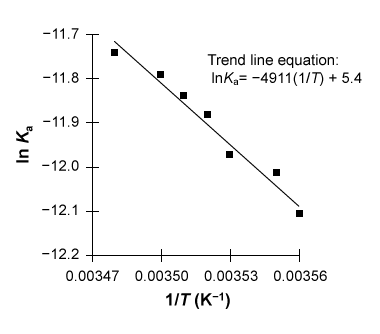 Figure 1 Linear van 't Hoff plot relating the dissociation constant Ka of acetic acid to temperature TThe relationship between Ka, T, ΔH°, and ΔS° in the van 't Hoff plot was then described using a linear fit of the data following the form of Equation 1, in which R is the gas constant (8.3 J∙mol−1∙K−1) .
 Adapted from: C. Rezsnyak "Determination of Thermodynamic Values (S°, H°, and G°) from the Dissociation of a Weak Acid" World Journal of Chemical Education. ©2017 Science and Education Publishing.
-During the dissociation of acetic acid at the temperatures tested in Table 1, the molecular disorder within the reaction vessel:
A) increases, and the energy of the reactants is greater than the energy of the products.
B) increases, and the energy of the reactants is less than the energy of the products.
C) decreases, and the energy of the reactants is greater than the energy of the products.
D) decreases, and the energy of the reactants is less than the energy of the products.
Correct Answer:

Verified
Correct Answer:
Verified
Q228: At the end of the actinium nuclear
Q229: Passage<br>The tendency of a chemical species to
Q230: Some models of rechargeable hearing aids use
Q231: Passage<br>Living organisms that require oxygen to respire
Q232: A radioactive atom decays by 5 alpha,
Q234: Passage<br>Copper plays a vital role as a
Q235: The emission line spectra of hydrogen, lithium,
Q236: Passage<br>Hyperbaric oxygenation therapy involves placing a patient
Q237: The boiling point of CH<sub>3</sub>CH<sub>2</sub>Br (bromoethane) is
Q238: Passage<br>Dmitri Mendeleev is credited with grouping the