Passage Combustion Occurs When an Oxidation-Reduction Reaction Takes Place Between a a Reduced
Multiple Choice
Passage
Combustion occurs when an oxidation-reduction reaction takes place between a reduced fuel source and an oxidizer, most frequently oxygen. The reaction between hydrogen and oxygen forms water (Reaction 1) and is highly exothermic and thermodynamically favorable. At the completion of hydrogen combustion, essentially all H2 molecules have been converted to water. Nevertheless, at room temperature and atmospheric pressure, molecular hydrogen and oxygen can coexist quite stably.2 H2 + O2 → 2 H2OReaction 1A group of researchers designed two prototype internal combustion engines, each of which could inject a hydrogen/oxygen mixture into a 5-mL combustion chamber at a total pressure of 1 atm and could repeat this process for several cycles. In one engine design, a spark was generated to initiate combustion as hydrogen and oxygen were injected. In another method, the combustion chamber was coated with a small amount of platinum powder. Platinum dramatically increases the reaction rate at room temperature without the need for a spark. The platinum itself is not altered by the reaction and can be reused. Researchers measured the maximum power output of both engine designs under identical injection and temperature conditions (Figure 1) .
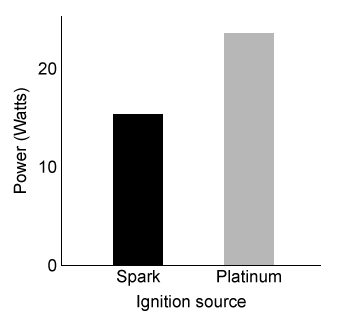 Figure 1 Relative power outputs of hydrogen engines with different ignition sources at 298 KThe power output of an engine is directly related to the rate of combustion. In the presence of platinum, researchers measured the engine's rate of water production at various temperatures and H2/O2 mixture compositions. The results are shown in Figure 2.
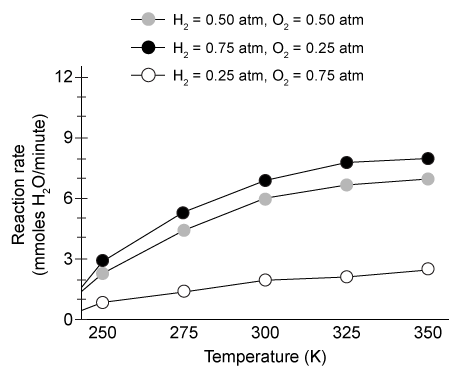 Figure 2 Rate of combustion in platinum-coated engines under various conditions
Adapted from Schultze M, Mantzaras J. Hetero-/homogeneous combustion of hydrogen/air mixtures over platinum: Fuel-lean versus fuel-rich combustion modes doi: 10.1016/j.ijhydene.2013.06.069
-Assuming the combustion of hydrogen behaves like an elementary reaction with respect to its rate, which of the following explains why an increase in the H2/O2 ratio causes an increase in the reaction rate?
A) Pauli exclusion principle
B) Law of mass action
C) Boyle's law
D) Henry's law
Correct Answer:

Verified
Correct Answer:
Verified
Q208: Passage<br>Cyanide (CN<sup>−</sup>) is a powerful, rapid toxin
Q209: What are the correct formal charges for
Q210: Passage<br>Umami is one of five basic tastes
Q211: Passage<br>Although acetylsalicylic acid (aspirin) is a well-known
Q212: Passage<br>In polluted urban environments, airborne proteins can
Q214: Passage<br>Students were asked to bring items from
Q215: Passage<br>Living organisms that require oxygen to respire
Q216: Ozone (O<sub>3</sub>) in the atmosphere protects against
Q217: Passage<br>Hyperbaric oxygenation therapy involves placing a patient
Q218: Which of the following statements describe a