Multiple Choice
Passage
Depending on the active compound's specific method of action, sunscreens are broadly classified into two groups: organic and inorganic. Organic sunscreens typically contain aromatic compounds that absorb ultraviolet (UV) radiation. The absorbed energy from the UV radiation causes these compounds to enter electronically excited states which then relax back to the ground state and harmlessly re-emit the absorbed radiation as heat. Alternatively, inorganic sunscreens contain metallic nanoparticles that serve to reflect, scatter, and absorb incident radiation. The mechanism for UV protection of each group is shown in Figure 1.
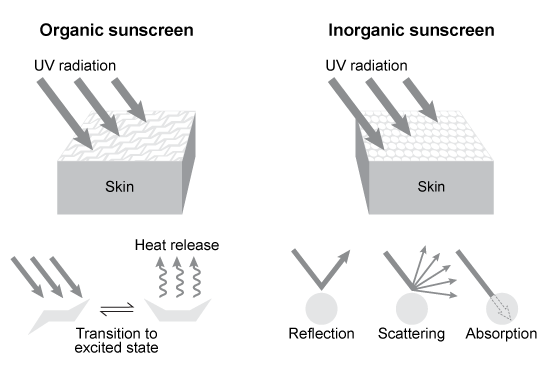 Figure 1 Method of action for organic and inorganic sunscreensThe effectiveness of sunscreens is traditionally evaluated based on their ability to prevent reddening of the skin, as indicated by their sun protection factor (SPF) . However, studies have shown that additional deleterious effects, such as the suppression of T cell-mediated immune responses, can occur at lower UV doses than erythema, indicating the need for new metrics to judge sunscreen efficacy. For this reason, researchers conducted a study to compare the protective ability of six sunscreens against photo-isomerization of the photoreceptor trans-urocanic acid (UCA) to its cis form, a process believed to be linked to UV-induced immunosuppression. Table 1 lists the sunscreens tested and their relevant characteristics.Table 1 Results from Tested Sunscreens
 In vivo experiments were conducted on two groups of human volunteers. Participants in the acute exposure group received a single UV dose of 100 mJ/cm2 whereas participants in the chronic exposure group received the same dosage once daily over four consecutive days. Each sunscreen was applied to a different spot on the volunteers' back prior to irradiation. A portion of skin without sunscreen was also irradiated to serve as a control. After irradiation, the sunscreens were removed and the skin was wiped with filter papers. Filters were washed with potassium hydroxide, and the aqueous solution was analyzed for UCA using high-pressure liquid chromatography. Figure 2 shows the mean percentages of cis-UCA formed upon irradiation for each exposure type and sunscreen tested.
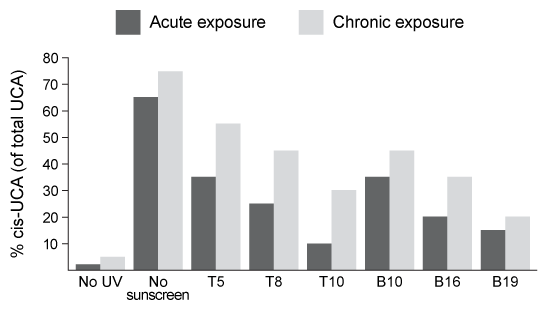 Figure 2 Percentage of UCA in cis configuration upon UV exposure with various sunscreens
Adapted from Van der molen RG, Out-luiting C, Driller H, Claas FH, Koerten HK, Mommaas AM. Broad-spectrum sunscreens offer protection against urocanic acid photoisomerization by artificial ultraviolet radiation in human skin. J Invest Dermatol. 2000;115(3) :421-6.
-Based on the results from the experiment in Figure 2, which of the following conclusions can be drawn?
A) Acute exposure to UV radiation leads to greater immunosuppression than chronic exposure.
B) Without sunscreen, UV radiation causes one in three UCA molecules to become cis isomers.
C) T10 and B19 offer the best protection against acute and chronic UV exposure, respectively.
D) T5 offers the best overall protection from UV radiation.
Correct Answer:

Verified
Correct Answer:
Verified
Q164: Passage<br>An automated external defibrillator (AED) is a
Q165: Which gas would occupy more volume at
Q166: Passage<br>Heme is found in several proteins, including
Q167: Passage<br>Students conducted an experiment to determine the
Q168: Passage<br>Oxytocin is a naturally occurring peptide hormone
Q170: Passage<br>A group of students were given water
Q171: Passage<br>Bone growth and remodeling during fracture healing
Q172: Passage<br>Heme is found in several proteins, including
Q173: Passage<br>Hyperbaric oxygenation therapy involves placing a patient
Q174: Passage<br>The bicarbonate (HCO<sub>3</sub><sup>−</sup>) buffer system (Reaction 1)