Multiple Choice
Passage
The bicarbonate (HCO3−) buffer system (Reaction 1) helps to maintain acid-base homeostasis and a blood pH near 7.4. Therefore, concentrations of carbon dioxide (CO2) and HCO3− must be tightly regulated through adaptations in respiratory and renal physiology. For patients with suspected acid-base imbalance, these concentrations can be monitored by blood gas analysis performed on arterial or venous blood.
 CO2g+H2Ol⇔carbonic anhydraseH2CO3aq⇔pKa=6.35HCO3-aq+H+aqReaction 1In most automated blood gas analyzers, ionized hydrogen, CO2, and oxygen (O2) in the sample diffuse through semipermeable membranes and are measured at separate electrodes (Figure 1) . The pH-sensitive glass electrode (E1) is separated from the blood sample by a membrane permeable to hydrogen ions. The sample pH is determined according to the voltage difference between E1 and a reference electrode maintained in a solution of standard pH. CO2 diffuses across a gas-permeable membrane to E2, where it reacts to generate HCO3− and free hydrogen ions. In a modification of the mechanism used in E1, partial pressure of CO2 (PaCO2) is calculated indirectly from the change in pH, as determined by the potential difference between E2 and its reference electrode.E3, also called the Clark electrode, is an electrochemical cell containing a silver anode and a platinum cathode. O2 diffuses through another gas-permeable membrane and reacts with hydrogen ions to form water. The current measured at E3 is then used to calculate PaO2 in the blood sample.
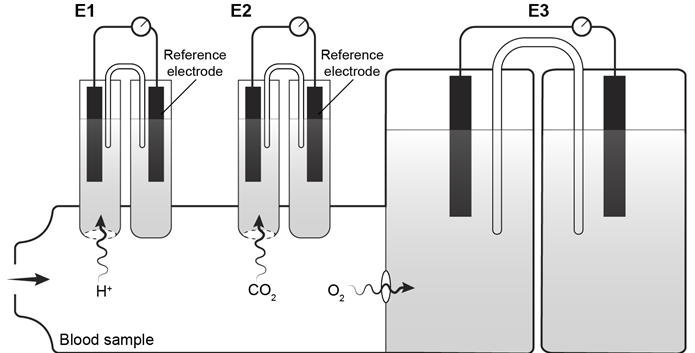 Figure 1 Automated blood gas analyzerThe concentration of carbonic acid (H2CO3) , reported in milliequivalents per liter (mEq/L) , can be calculated from PaCO2 by Equation 1:
 H2CO3mEqL=0.03×PaCO2mm HgEquation 1Subsequently, using the concentration of H2CO3 obtained from Equation 1, the HCO3− concentration resulting from decomposition of carbonic acid can then be calculated by applying the Henderson-Hasselbalch equation.
-Blood gas analysis results are listed below. From the data, determine the HCO3− concentration in the blood sample resulting from the decomposition of carbonic acid. 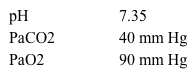
A) 0.12 mEq/L
B) 1.2 mEq/L
C) 2.4 mEq/L
D) 12.0 mEq/L
Correct Answer:

Verified
Correct Answer:
Verified
Q154: Which statement correctly describes both the 3s
Q155: Passage<br>Potassium permanganate (KMnO<sub>4</sub>) is a highly reactive
Q156: The emission line spectrum of hydrogen displays
Q157: Passage<br>Kidney stones are a common ailment affecting
Q158: Passage<br>Within the renal system, two buffers operate
Q160: Passage<br>Potassium permanganate (KMnO<sub>4</sub>) is a highly reactive
Q161: Given that acetic acid (CH<sub>3</sub>COOH) has pK<sub>a</sub>
Q162: Passage<br>The bicarbonate (HCO<sub>3</sub><sup>−</sup>) buffer system (Reaction 1)
Q163: Phosphorus-32 is a radioactive beta-emitter used in
Q164: Passage<br>An automated external defibrillator (AED) is a