Multiple Choice
Passage
Each time a eukaryotic cell replicates its DNA, the telomeres at the ends of each chromosome become slightly shorter. When telomeres reach a critically short length, the cells enter the senescent state, in which cell division ceases (Figure 1) . In humans, conditions such as hypertension, liver disease, and Alzheimer disease have been associated with the decreased telomere length and resulting senescence that occur as part of the normal aging process.
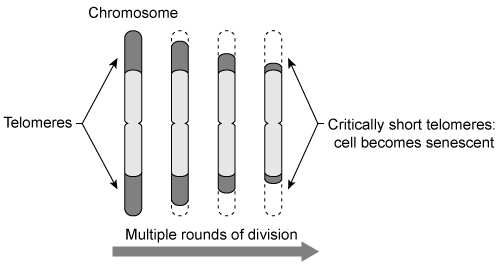 Figure 1Cells that must be able to divide indefinitely (stem cells and germ cells) express an enzyme known as telomerase. Functional telomerase consists of a protein subunit called telomerase reverse transcriptase (TERT) and a noncoding RNA subunit called telomerase RNA (TR) . Using a portion of TR as a template, telomerase extends telomeres by continuously adding the sequence 5′-TTAGGG-3′ to the ends of chromosomes. The complement strand is then filled in by DNA polymerase. Telomere extension allows these cells to avoid senescence.In healthy somatic cells, however, TERT transcription is generally downregulated by the absence of the oncogene c-Myc and the presence of the tumor suppressor protein WT1. When telomerase is suppressed, the resulting critical telomere shortening has been hypothesized to prevent uncontrolled cell proliferation in adult tissues. In cancerous somatic cells, on the other hand, increased telomerase activity is often associated with tumorigenesis. WT1 is frequently absent and c-Myc is frequently overexpressed in these cells, leading to increased TERT expression.In addition to transcriptional control, TERT can be regulated at the post-transcriptional level. The TERT gene consists of 16 exons and 15 introns that can be spliced into more than 20 different isoforms in humans. Only one isoform (the active isoform) is known to extend telomeres. However, the i2 isoform, in which intron 2 is partially included in the mature mRNA (Figure 2) , has been hypothesized to downregulate residual TERT activity in somatic cells.
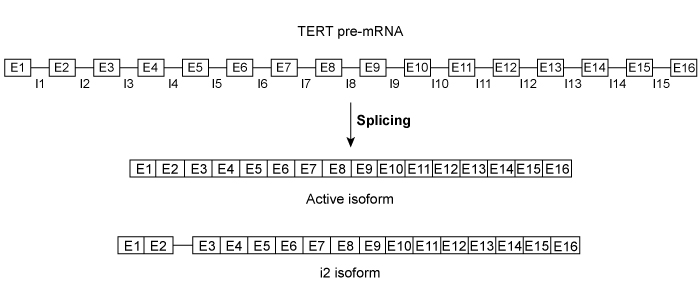 Figure 2
Adapted from Cifuentes-rojas C, Shippen DE. Telomerase regulation. Mutat Res. 2012;730(1-2) :20-7.
-Some eukaryotic organisms have multiple TERT genes with high sequence similarity that are expressed at different times in the organism's life cycle. These genes could have arisen by:
A) alternate splicing.
B) conjugation.
C) gene duplication.
D) transformation.
Correct Answer:

Verified
Correct Answer:
Verified
Q67: Passage<br>Skin grafting is a procedure in which
Q68: Passage<br>The lumen of the human gut is
Q69: Passage<br>The sex chromosomes X and Y are
Q70: Passage<br>The Namibian cheetah (Acinonyx jubatus jubatus), the
Q71: Passage<br>Skin grafting is a procedure in which
Q73: In humans, meiosis and mitosis are most
Q74: Passage<br>Alzheimer disease (AD) is a progressive condition
Q75: Passage<br>Autosomal dominant polycystic kidney disease (ADPKD) is
Q76: Passage<br>Eukaryotic organelles such as mitochondria and chloroplasts
Q77: Passage<br>Endometriosis is a chronic, treatable disease of