Multiple Choice
Passage
Saliva, a secreted fluid with multiple physiologic functions, is composed of water (~99%) , proteins, and electrolytes. Together, these components facilitate nutrient consumption, respiration, and communication. For example, saliva aids in digestion by serving as a lubricant during mastication and by initiating carbohydrate and fat metabolism. In addition, the calcium and phosphate present in saliva promote tooth remineralization, and antimicrobial and chemical buffering agents give saliva protective properties.The gustatory-salivary reflex, the secretion of saliva from the salivary glands in response to gustation (taste) , is primarily mediated by the parasympathetic division of the nervous system. In general, parasympathetic pathways originate from the brain stem or the sacral spinal cord. Fibers originating from nuclei in these regions synapse onto ganglia that lie in close proximity to the target organ. Both preganglionic neurons (those originating from the nuclei) and postganglionic neurons (those originating from the ganglia) release acetylcholine (ACh) .In the gustatory-salivary reflex, activation of taste receptors in the tongue sends impulses to the superior and inferior salivatory nuclei in the brainstem. Local processing within these nuclei activates the parasympathetic pathways that innervate the salivary glands. Ultimately, ACh released from postganglionic neurons acts on the muscarinic acetylcholine receptors (mAChRs) on the secretory cells of the salivary gland to stimulate salivation (Figure 1) .
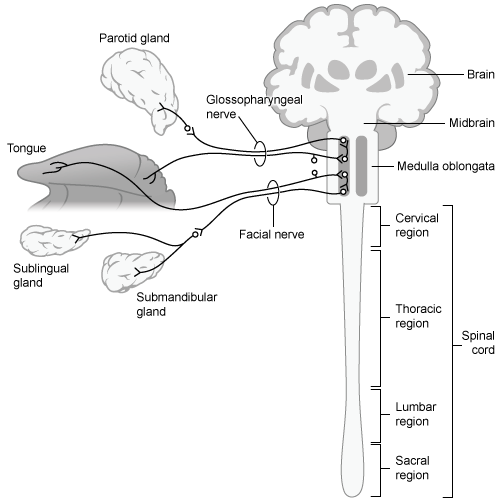 Figure 1 Parasympathetic regulation of salivary secretionSympathetic stimulation of the salivary glands also promotes salivation but to a lesser degree than parasympathetic stimulation. This may contribute to what is often perceived to be decreased salivation when the sympathetic division is more active than its counterpart. Unlike parasympathetic pathways, sympathetic pathways originate in the thoracic and lumbar spinal segments, and the ganglia lie in close proximity to the spinal cord. Although preganglionic neurons of the sympathetic nervous system release ACh, the postganglionic neurons often release norepinephrine.
-The graph below shows the firing rate of preganglionic neurons within the rat gustatory-salivary reflex arc when the lateral hypothalamic area (LHA) is electrically stimulated at various time intervals before the tongue is stimulated. The results are compared to the preganglionic firing rate following tongue-only stimulation, which was used as a baseline that represented 100% activity. 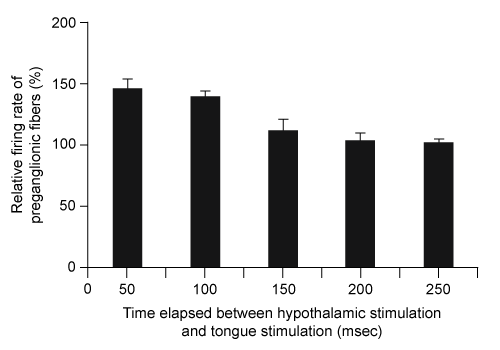 The results of this experiment indicate that at shorter time intervals:
A) LHA signaling has no effect on the magnitude of salivation of the reflex.
B) LHA signaling increases the magnitude of salivation of the reflex.
C) LHA signaling decreases the magnitude of salivation of the reflex.
D) There is not enough data to determine the effect of LHA signaling on the reflex.
Correct Answer:

Verified
Correct Answer:
Verified
Q89: Impaired release of which of the following
Q90: Following digestion in the small intestine, certain
Q91: Passage<br>Neurulation refers to the early formation of
Q92: Passage<br>Viruses are known as obligate intracellular parasites
Q93: Which statement most accurately describes the role
Q95: Passage<br>Obstructive respiratory illnesses are characterized by an
Q96: Passage<br>Spinal muscular atrophy (SMA) is an autosomal
Q97: Passage<br>At the blood-brain barrier, the cerebral spinal
Q98: Passage<br>The fruit fly Drosophila melanogaster is frequently
Q99: Passage<br>Parathyroid hormone (PTH) is an important regulator