Multiple Choice
Passage
Obesity is a condition that affects over 30% of adults in the United States and is associated with comorbidities such as type 2 diabetes mellitus, heart disease, and cancer. For individuals with clinically severe obesity, defined as having a body mass index above 40 kg/m2, lifestyle interventions may produce insufficient weight reduction. Weight loss surgery, such as Roux-en-Y gastric bypass (RYGB) , has proved to be the most effective clinical intervention for facilitating massive and immediate weight loss in clinically obese patients.In RYGB, the stomach is first divided into a small gastric pouch and a distal gastric remnant, which remains attached to the duodenum. Next, the jejunum is transected and its lower section is connected to the newly created gastric pouch to form the alimentary limb. This connection is typically created with surgical staples. The formation of the alimentary limb allows ingested food to bypass the region composed of the distal gastric remnant, the duodenum, and the upper jejunum; collectively termed the biliopancreatic limb. Finally, the lumen of the upper jejunum is reconnected to the lumen of the lower jejunum to allow enzymes and compounds to flow freely from the biliopancreatic limb into the alimentary limb.
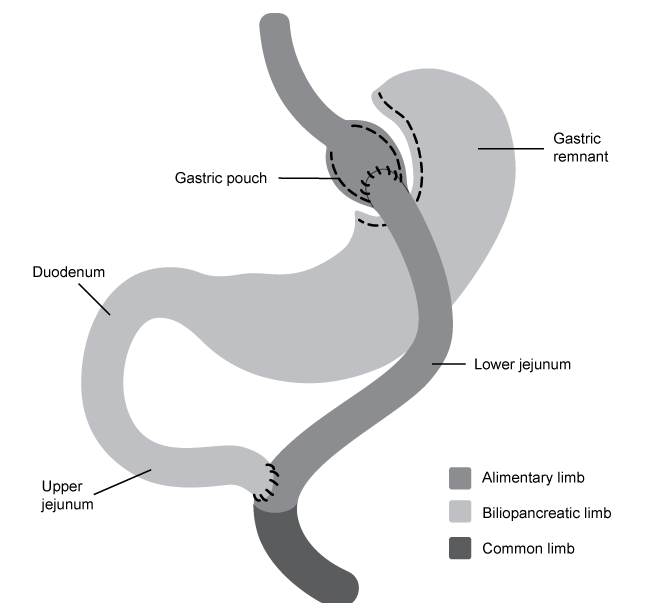 Figure 1 RYGB surgically divides the digestive tract into the alimentary limb and the biliopancreatic limb, which then merge into the common limb.RYGB facilitates weight loss by reducing the functional volume of the stomach and altering intestinal anatomy to induce nutrient malabsorption. However, the procedure is associated with several complications, such as steatorrhea, or fatty stools, due to disruption of lipid digestion. Animal studies also suggest that RYGB promotes the growth of weight loss-inducing gut bacteria. Researchers have found that transplanting gut microbiota of obese postoperative RYGB mice into nonoperated, obese mice lacking gut flora may reproduce the therapeutic effects of RYGB in transplant-recipient mice.
Adapted from Bächler T, Le roux CW, Bueter M. How do patients' clinical phenotype and the physiological mechanisms of the operations impact the choice of bariatric procedure?. Clin Exp Gastroenterol. 2016;9:181-9.
-In RYGB patients, ingested food will NOT pass through the:
A) cardiac sphincter.
B) intestinal villi.
C) pyloric sphincter.
D) cecum.
Correct Answer:

Verified
Correct Answer:
Verified
Q36: Passage<br>Endometriosis is a chronic, treatable disease of
Q37: Human sperm and oocytes are substantially different
Q38: Passage<br>Renal reabsorption of glucose is facilitated by
Q39: Passage<br>The lac operon encodes the proteins that
Q40: Passage<br>Overexpression of the miR-17~92 gene cluster occurs
Q42: Passage<br>Trypanosoma brucei is a eukaryotic parasite that
Q43: Passage<br>In 1906, the Nobel Prize in Physiology
Q44: In a neuron, mitochondrial biogenesis is believed
Q45: Passage<br>The adrenal glands are divided into two
Q46: Passage<br>Obstructive respiratory illnesses are characterized by an