Multiple Choice
Passage
The HIV-derived transactivator of transcription (Tat) is a short peptide with the sequence RKKRRQRRRPPQ. When paired with liposomes (ie, synthetic vesicles) composed of cationic lipids, Tat can transport large molecules across cell membranes and has been studied as a vector for gene therapy. However, Tat delivers cargo to cells with relatively low efficiency. Researchers hypothesized that a Tat homodimer could yield stronger DNA binding than the monomer, which may improve the efficiency of DNA delivery.To study this hypothesis, Tat and two variant peptides (Variants 1 and 2) were produced by solid-phase peptide synthesis, in which the growing peptide chain is immobilized on polystyrene beads. Unlike biological systems, solid-phase synthesis assembles peptides from the C-terminus to the N-terminus, as shown in Figure 1.
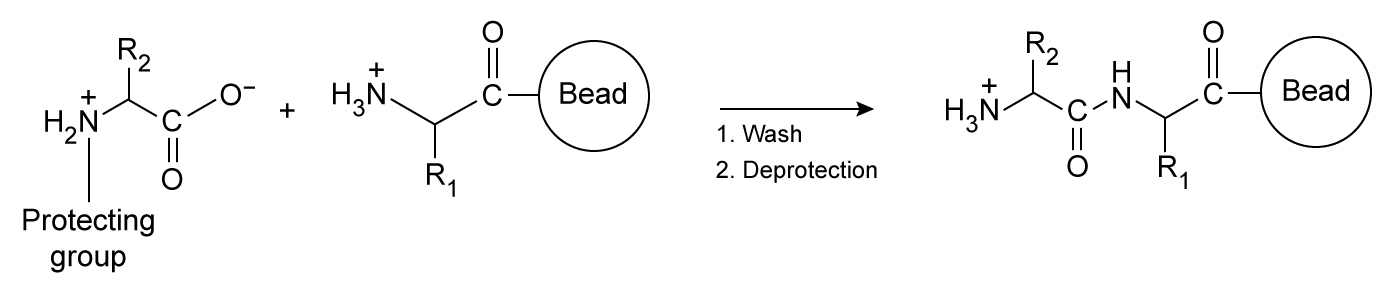 Figure 1 Simplified schematic of one round of solid-phase peptide synthesis. The protecting group is removed during deprotection. The process is repeated until the peptide is complete.Variants 1 and 2 contained a C-terminal and an N-terminal cysteine residue, respectively. Each variant was allowed to dimerize by disulfide bond formation. Peptide-DNA binding interactions were then studied by mixing varying amounts of each peptide with plasmid DNA encoding luciferase protein (pLuc) . The resulting peptide-DNA complexes were run on agarose gels, with results displayed in Figure 2.
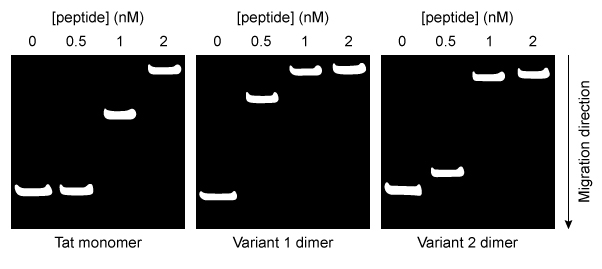 Figure 2 Agarose gel results for pLuc plasmid exposed to varying amounts of each peptideEqual concentrations of each type of peptide-DNA complex were then incubated with cationic liposomes and exposed to cultured cells for 24 hours. The cells were then assessed for luciferase activity. Greater luciferase activity indicated more efficient delivery of the pLuc plasmid. The results are shown in Figure 3.
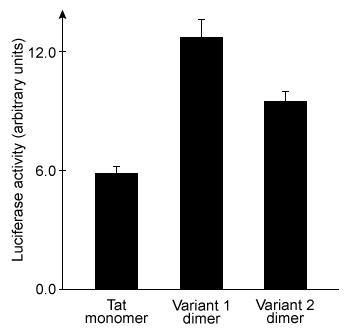 Figure 3 Plasmid delivery efficiency of three peptides, as measured by induced luciferase activity
Adapted from Lee S-J, Yoon S-H, Doh K-O. Enhancement of gene delivery using novel homodimeric tat peptide formed by disulfide bond. J Microbiol Biotechnol. 2011;21(8) :802-807.
-The addition of which reagent would result in the greatest amount of dimerization of the Tat variants?
A) A strong acid such as HCl
B) A strong base such as NaOH
C) A reducing agent such as dithiothreitol
D) An oxidizing agent such as oxygen gas
Correct Answer:

Verified
Correct Answer:
Verified
Q157: Researchers isolate a protein that runs as
Q158: Passage<br>Many lysosomal proteins are transported to the
Q159: Passage<br>Oxidative stress occurs in cells when reactive
Q160: Proline differs from the other standard amino
Q161: Passage<br>The tumor suppressor p53 is a homotetrameric
Q163: Passage<br>The bacterium Clostridium difficile secretes protein toxins
Q164: Passage<br>The influenza A virus is an enveloped
Q165: Passage<br>Dystroglycan (Dg) is a transmembrane protein that
Q166: Passage<br>Nerve cells must maintain the composition of
Q167: Which experimental procedure(s) must scientists use to