Multiple Choice
Passage
Many cephalopods can change color to blend in with their surroundings by altering the conformations of particular proteins within their skin cells. The reflectin proteins play a major role in this camouflage mechanism. Reflectins are a group of intrinsically disordered proteins that do not adopt clearly defined secondary or tertiary structures. Under certain conditions reflectins aggregate, allowing cells to reflect various wavelengths of light.Skin cells from the squid Doryteuthis opalescens were cultured and three reflectins-DoRA, DoRB, and DoRC-were purified and analyzed to determine amino acid composition. They were found to contain an abundance of arginine and serine but relatively few cysteine, leucine, isoleucine, valine, phenylalanine, or tryptophan residues. Figure 1 shows the relative hydrophobicity of each reflectin variant as a function of amino acid position.
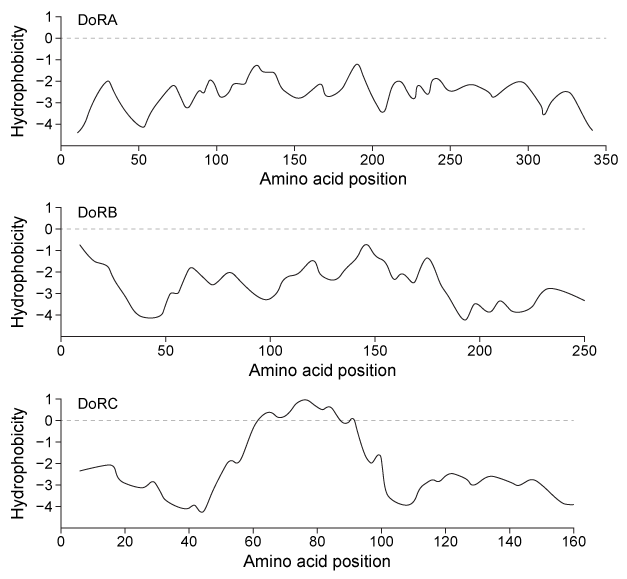 Figure 1 Hydrophobicity plots of three reflectins isolated from D. opalescens. (Note: Negative numbers indicate hydrophilic regions.) In D. opalescens skin cells (pH ≈ 7.8) , reflectins aggregate in response to acetylcholine (ACh) , which causes a signal cascade that changes the phosphorylation state of the proteins. Cells were incubated with or without ACh, and DoRA and DoRB were purified and assessed for phosphorylation by mass spectrometry. DoRA became phosphorylated in the presence of ACh whereas DoRB became dephosphorylated. After examining the isoelectric points of unmodified DoRA and DoRB, as shown in Figure 2, scientists proposed that reflectins aggregate upon charge neutralization.
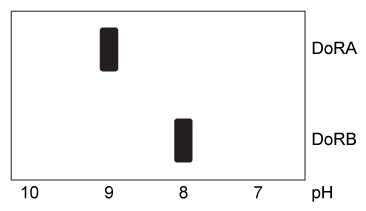 Figure 2 Isoelectric focusing of DoRA and DoRB
Adapted from Demartini DG, Izumi M, Weaver AT, Pandolfi E, Morse DE. Structures, Organization, and Function of Reflectin Proteins in Dynamically Tunable Reflective Cells. J Biol Chem. 2015;290(24) :15238-49.
-In the absence of ACh, which of the following bond types best characterizes the structure of reflectins?
A) Hydrogen bonds between backbone carbonyls and amides
B) Covalent bonds between sulfur atoms
C) Hydrogen bonds between R group alcohols
D) Covalent bonds between carbon and nitrogen atoms
Correct Answer:

Verified
Correct Answer:
Verified
Q244: If a stretch of double-stranded DNA has
Q245: Passage<br>Glycolysis and gluconeogenesis are tightly regulated, opposing
Q246: The electron transport chain results in the
Q247: Passage<br>The cystic fibrosis transmembrane conductance regulator (CFTR)
Q248: A protein consisting of domains A, B,
Q250: Passage<br>The HIV-derived transactivator of transcription (Tat) is
Q251: Passage<br>Glycolysis and gluconeogenesis are tightly regulated, opposing
Q252: Which statement accurately describes a substrate in
Q253: Passage<br>Spinocerebellar ataxia 3 (SCA3) is a neurodegenerative
Q254: Passage<br>Leptin signaling is vital for maintaining adequate